Heart Failure Home Care
Weight monitoring, diuretic management and prevention of decompensation at home.
30+
Verified registered nurses
< 60min
On site in under 60 min
24/7
Available 24/7
22
areas covered
Understanding the condition
Heart failure is a chronic disease in which the heart no longer pumps efficiently enough, leading to breathlessness, fatigue and fluid retention. In Morocco, it is a frequent cause of repeated hospitalisations, often avoidable through close follow-up. Daily life calls for great rigour: a daily weigh-in, a low-salt diet, the precise taking of several medications and the recognition of warning signs. Many patients, particularly elderly ones, struggle to keep to this framework on their own. Our qualified nurses, employed by SOS Nursing, provide home-based monitoring of weight, treatment management and the early detection of decompensation in Marrakech, in close coordination with the cardiologist and the treating physician. This structured follow-up aims to stabilise the disease and to clearly reduce re-hospitalisations.
Our care services for this condition
Home nursing services specifically tailored to your medical situation.
Why home care for Heart Failure Home Care
Regular nursing follow-up at home makes it possible to detect decompensation at its first signs and to appreciably reduce the re-hospitalisations linked to heart failure.
What the nurse does at every visit
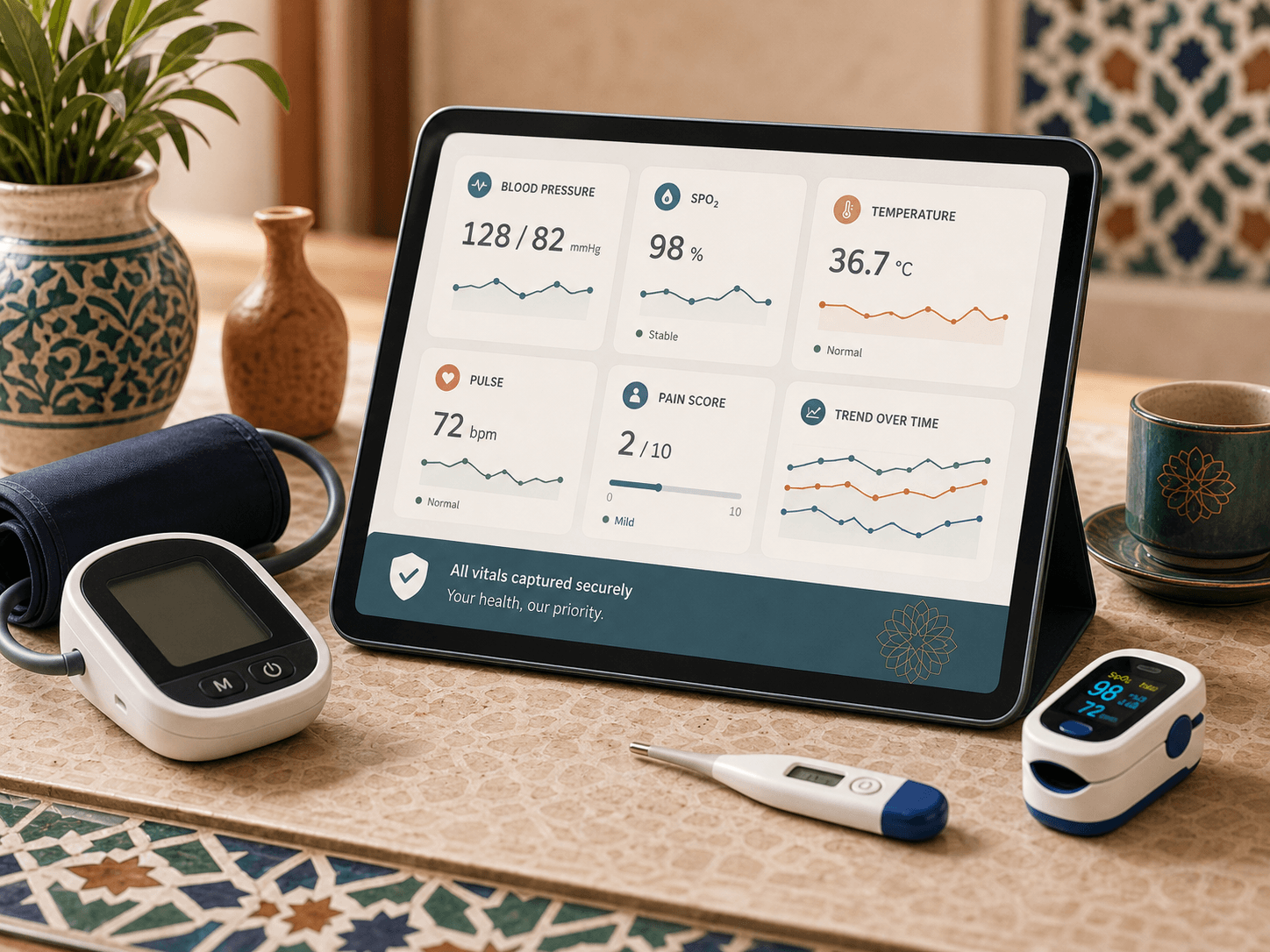
Weigh-in, measurement of blood pressure and pulse, a search for oedema and breathlessness, auscultation, checking that medication is being taken and assessment of treatment tolerance.
Visit frequency and monitoring
Daily visits during the unstable phase or on return from hospital, then 2 to 3 times a week during the stable phase. The weight chart is a central reference point, monitored at every visit.
Coordination with your treating physician
Weight, blood pressure and signs of decompensation are passed on to the cardiologist. The adjustment of diuretics and other treatments is the physician's responsibility; the nurse applies it and monitors.
Equipment and home monitoring
Scales, blood pressure monitor, pulse oximeter, monitoring of oedema. On prescription, the nurse can administer diuretics intravenously and monitor the associated parameters.
The family's role between visits
We teach relatives to weigh the patient every morning, to limit salt and fluid intake, and to recognise the warning signs (rapid weight gain, breathlessness, swelling of the legs).
AMO / CNSS coverage
Heart failure falls under long-term illnesses (ALD). Nursing acts (AMI) are coded according to the NGAP and reimbursable by AMO/CNSS, with a compliant coded receipt and a signed care record.
Frequently asked questions
During the unstable phase or on return from hospital, daily visits are recommended. Once the situation is stable, 2 to 3 visits a week are generally enough to maintain effective monitoring.
Yes, on the cardiologist's prescription. Our nurses are trained in the administration of intravenous diuretics and in monitoring the associated parameters (blood pressure, urine output, signs of dehydration).
Yes. It is a long-term illness (ALD); nursing acts (AMI) coded according to the NGAP qualify for AMO/CNSS reimbursement. We provide a compliant coded receipt at every visit.
Rapid weight gain (for example 2 kg in two to three days) signals fluid retention and the onset of decompensation. Spotting it early makes it possible to act before it worsens and to avoid hospitalisation.
Faced with marked breathlessness at rest or sudden weight gain, the nurse applies the alert protocol, contacts the cardiologist and, if the condition warrants it, mobilises our private ambulance service to a clinic.
Through daily monitoring of weight, blood pressure and signs of decompensation, education of the patient and family, and regular communication with the cardiologist to adjust treatment in time.
Other conditions we treat
Heart Failure Home Care
Life-threatening emergency? Call SAMU 141.