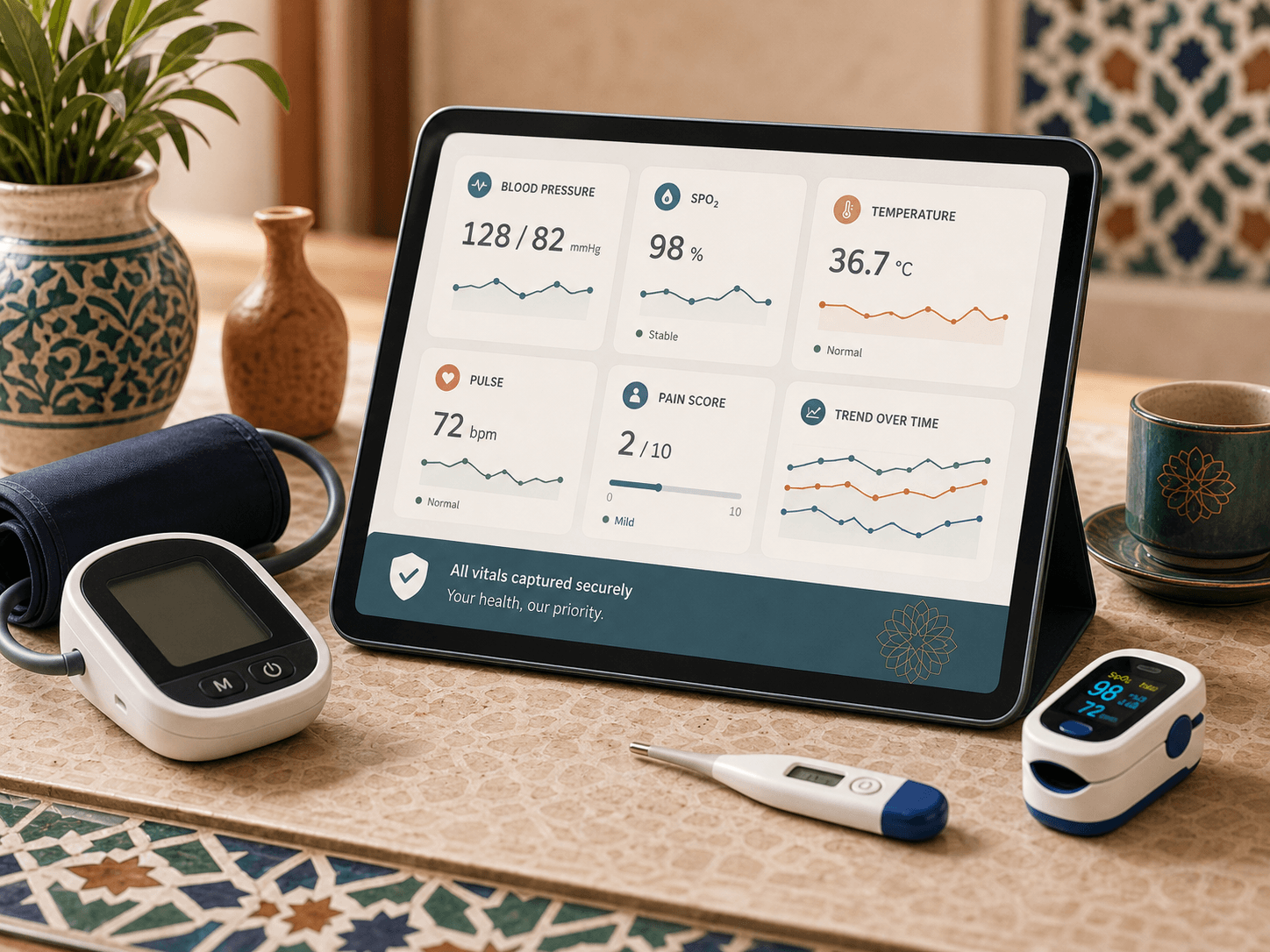
Chronic conditions
Diabetes, hypertension, kidney failure: injections and vital-sign monitoring.
30+
Qualified nurses
< 60min
Response time
24/7
Availability
22
Coverage zones
What this care involves
Vital-sign checks, medication administration, patient education and regular updates to the doctor to stabilise the condition over time.
What's included
- Blood pressure, glucose and weight tracking
- Prescribed injections and medication review
- Symptom check for the specific condition
- Practical education on diet and warning signs
- Regular report to your treating doctor
What to expect
Vital signs check
Blood pressure, capillary blood glucose, weight, heart rate, oxygen saturation — the key parameters of your condition are measured and logged at every visit.
Treatment administration
Insulin injections, anticoagulants, subcutaneous infusions: the nurse performs the prescribed procedures in the comfort of your home.
Patient education
The nurse teaches you to recognise warning signs, adapt your diet and understand your lab results. The goal: making you an active participant in your own health.
Doctor reporting
A monitoring summary is sent to your GP at every visit cycle, including vital-sign trends and clinical observations.
The benefits
A stable condition, fewer crises
Steady monitoring of diabetes, hypertension or kidney and heart failure keeps figures in range and heads off the flare-ups that lead to hospital.
You learn to manage it
The nurse explains your treatment, your numbers and the signs that need a call, so you and your family feel in control rather than anxious.
Joined-up with your doctor
Trends and any concerns are reported to your treating physician, who can adjust the prescription without you having to travel for every check.
Who is this for
Insulin-dependent diabetes
You need daily injections, rigorous blood-glucose monitoring and dietary advice tailored to your lifestyle.
Hypertension or heart failure
Your treatment requires regular blood-pressure monitoring, weight tracking and vigilance for signs of decompensation.
Chronic kidney disease
You are on pre-dialysis or home peritoneal dialysis and need a nurse trained in nephrology protocols.
Five steps, zero grey areas.
From first contact to the final report, every moment is documented, traceable and transparent.
- 01
You make a request
By phone, WhatsApp or via the platform. Describe the situation: a coordinator takes over immediately.
Response in under 15 minutes - 02
Clinical triage
The coordinator assesses the situation in 90 seconds: SAMU 141 if life-threatening, an SOS nurse if urgent, or a same-day scheduled visit.
Professional clinical assessment - 03
Nurse assignment
The nearest qualified nurse receives the offer. 60 seconds to respond, otherwise the next one is alerted automatically.
Every nurse verified individually - 04
The visit
The nurse arrives, identity verified. Vital signs entered on tablet, procedures documented, record signed.
Verified identity + real-time tracking - 05
After the visit
Report sent to your treating doctor. Vital signs available as PDF. NGAP-coded receipt for your AMO/CNSS claims.
Complete documentation within 24h
Clinical details
Chronic disease follow-up at home is based on HAS (Haute Autorité de Santé) and WHO NCD protocols. For diabetes, the target is HbA1c below 7 % (or the target set by the diabetologist) through daily blood-glucose monitoring, insulin-dose adjustment on prescription and self-monitoring education. For hypertension, follow-up includes twice-daily blood-pressure measurement (morning and evening, reference arm, at rest), body-weight surveillance (fluid retention) and screening for target-organ damage (foot examination for diabetes, oedema check for heart failure). Each visit cycle generates a structured report sent to the GP, including vital-sign trends, treatment adherence and adjustment recommendations. This coordination reduces acute episodes and unplanned hospitalisations.
Frequently asked questions
It depends on how stable you are: anything from a daily insulin visit to a weekly review. We set the frequency with your doctor and increase it during an unstable spell, then ease off as things settle.
Yes. We work from your specialist’s prescription and send back vital signs, glucose logs and observations, so your endocrinologist, nephrologist or cardiologist always has up-to-date readings.
Prescribed nursing acts for long-term conditions are reimbursable under AMO and CNSS schemes. We provide a detailed invoice and the prescription reference so you can submit your claim easily.
I have been diabetic for 15 years. With the nurse visiting three times a week, my HbA1c dropped from 9.2 to 7.1 in six months. She taught me to eat differently — not just to inject.
Hassan M.
Patient, type 2 diabetes — Semlalia
Areas covered
- Guéliz< 20m
- Hivernage< 20m
- Semlalia< 25m
- Camp El Ghoul< 25m
- Médina< 25m
- Mellah< 25m
- Kasbah< 25m
- Bab Doukkala< 30m
- Palmeraie< 35m
- Sidi Ghanem< 35m
- Targa< 30m
- Ménara · Agdal< 30m
- Massira< 25m
- Daoudiate< 25m
- M'hamid< 30m
- Hay Al Izdihar< 30m
- Hay Mohammadi< 30m
- Sidi Youssef Ben Ali< 30m
- Chrifia · Route de l'Ourika< 35m
- Route de Safi< 35m
- Aïn Itti< 30m
- Tameslohte< 40m
Conditions we treat
Chronic conditions
Life-threatening emergency? Call SAMU 141.