COPD Home Care
Respiratory monitoring, home oxygen therapy and prevention of exacerbations.
30+
Verified registered nurses
< 60min
On site in under 60 min
24/7
Available 24/7
22
areas covered
Understanding the condition
Chronic obstructive pulmonary disease (COPD) is a progressive respiratory disease, most often linked to smoking, that gradually reduces breath and exercise capacity. In Marrakech, dust, certain occupational exposures and changes in the climate worsen breathlessness and encourage flare-ups. At advanced stages, home oxygen therapy becomes necessary. Daily life narrows: climbing stairs, walking, and sometimes speaking become difficult. Our qualified nurses, employed by SOS Nursing, provide respiratory monitoring, oxygen management and flare-up prevention at home, in coordination with the respiratory specialist and the treating physician. The aim is to reduce repeated hospitalisations, to make oxygen therapy safe and to preserve the patient's independence and quality of life for as long as possible.
Our care services for this condition
Home nursing services specifically tailored to your medical situation.
Why home care for COPD Home Care
Close respiratory monitoring at home makes it possible to spot a flare-up at its very onset, to act quickly and to avoid hospitalisations that are often long and gruelling.
What the nurse does at every visit
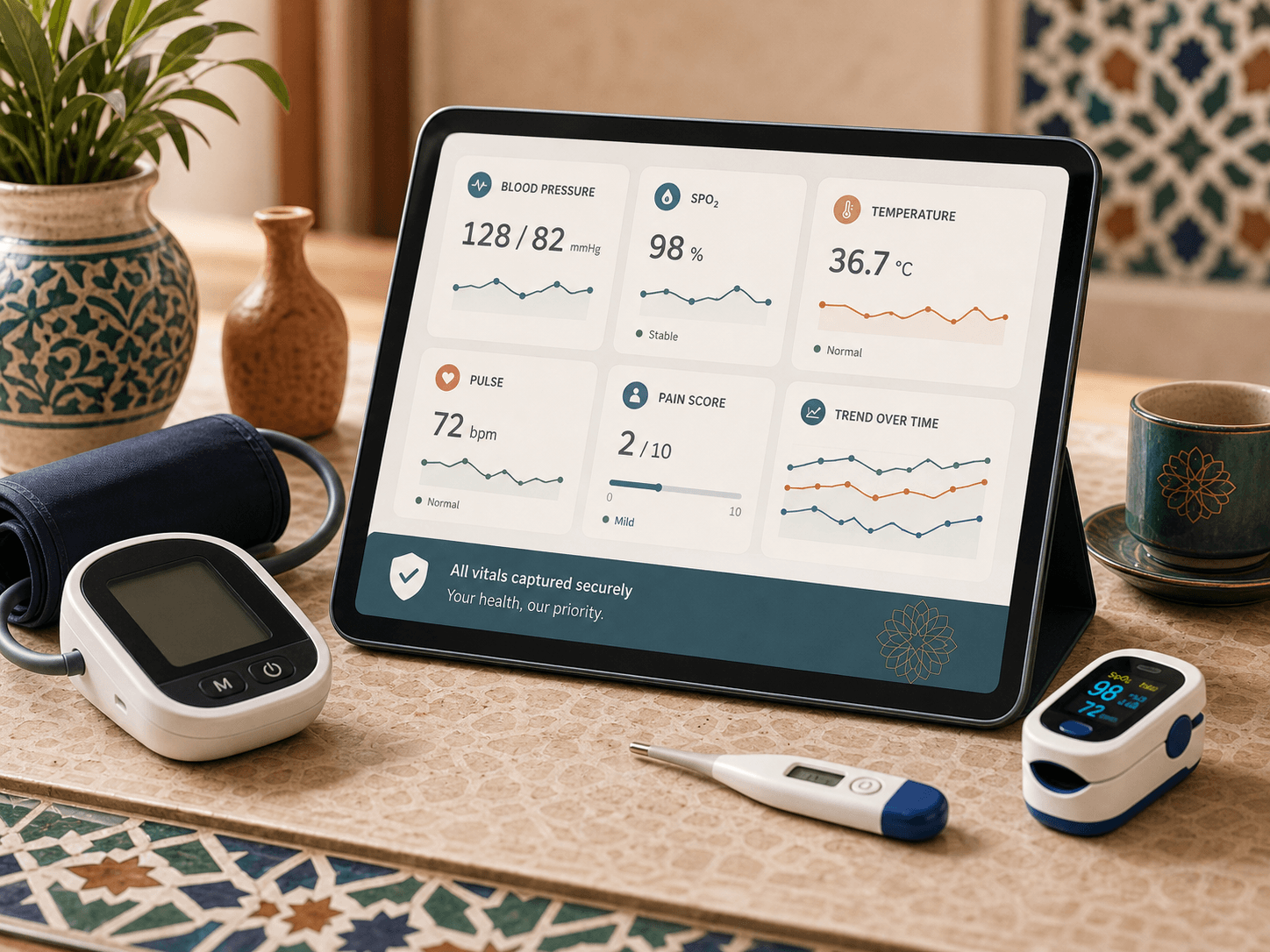
Measurement of oxygen saturation, auscultation, assessment of breathlessness and cough, checking of the oxygen-therapy and nebuliser equipment, and verification that inhaled treatments are being taken.
Visit frequency and monitoring
Several-times-weekly follow-up during the stable phase, reinforced during periods of fragility or after a hospitalisation. The frequency is adjusted to the stage of the disease and the oxygen requirement.
Coordination with your treating physician
Respiratory parameters and signs of a flare-up are passed on to the respiratory specialist and the treating physician. Oxygen therapy and treatments are administered according to their prescription.
Equipment and home monitoring
Pulse oximeter, support with the oxygen concentrator and cylinders, nebulisers and inhalation devices. The nurse checks the flow rates, the maintenance and the correct use of the equipment.
The family's role between visits
We train relatives in the safe use of oxygen (safety instructions), in recognising the signs of a flare-up and in the techniques that help breathing more easily in everyday life.
AMO / CNSS coverage
Severe COPD falls under long-term illnesses (ALD). Nursing acts (AMI) are coded according to the NGAP and reimbursable by AMO/CNSS, with a compliant coded receipt and a signed care record.
Frequently asked questions
Yes. Our nurses support the set-up, adjustment and monitoring of oxygen concentrators and cylinders, and train the patient and carers in safe daily use, in line with the safety instructions.
Yes. Faced with worsening breathlessness, a drop in saturation or a change in sputum, the nurse assesses, administers the prescribed treatments, alerts the respiratory specialist and, if necessary, mobilises our private ambulance service.
Severe COPD is recognised as a long-term illness (ALD). Nursing acts (AMI) coded according to the NGAP are reimbursable by AMO/CNSS. We provide a compliant coded receipt and a signed care record.
During the stable phase, several-times-weekly follow-up is most often sufficient. It is reinforced after a hospitalisation or during a period of respiratory fragility, in order to prevent a new flare-up.
Yes. Our nurses guide suitable breathing and mobilisation exercises, complementing respiratory physiotherapy sessions, to preserve lung capacity and tolerance to exertion.
We train relatives to monitor breathing and skin colour, to use oxygen safely, to maintain the equipment and to recognise the signs that call for a quick call to our coordination team, reachable around the clock.
Other conditions we treat
COPD Home Care
Life-threatening emergency? Call SAMU 141.