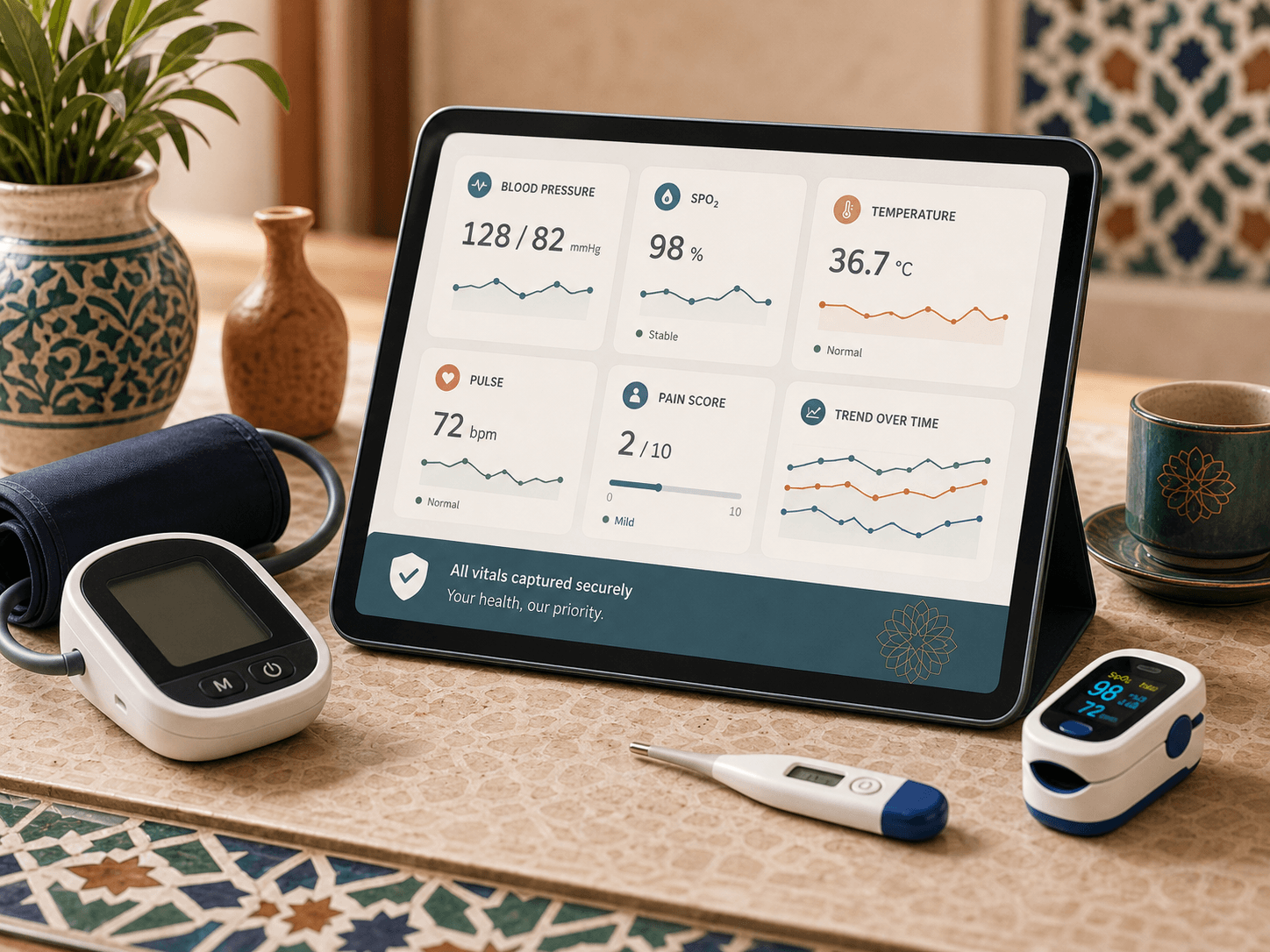
Vital-signs monitoring
Blood pressure, glucose, oxygen, temperature: regular checks at home.
30+
Qualified nurses
< 60min
Response time
24/7
Availability
22
Coverage zones
What this care involves
Measurement and recording of blood pressure, glucose, oxygen saturation and temperature, with an alert to the doctor at the first abnormal value.
What's included
- Blood pressure and pulse measurement
- Blood glucose reading
- Oxygen saturation and temperature check
- Recording every value in your file
- Alert to the doctor on any abnormal result
What to expect
Protocol set-up
The nurse agrees with your doctor which parameters to monitor, how often they should be measured and what alert thresholds apply to you.
Precise measurements
Blood pressure, blood glucose, oxygen saturation, temperature, heart rate, weight — each parameter is measured to a strict protocol and logged in a tracking chart.
Immediate interpretation
The nurse spots any abnormal value straight away and decides: reassure, adjust on prescription, or alert the treating doctor.
Data transmission
A structured monitoring summary is sent to the doctor at each cycle, making trends visible and allowing imbalances to be anticipated.
The benefits
Problems spotted early
Regular readings reveal a drifting blood pressure or glucose before it turns into a crisis, giving your doctor time to act.
No equipment to buy or learn
The nurse arrives with calibrated portable devices and takes accurate readings, so you do not have to wrestle with a home monitor.
A clear record you can share
Every value is logged and trends are easy to read, ready for your next consultation or for a remote review by your physician.
Who is this for
Post-hospitalisation monitoring
You have just left hospital and your doctor has requested close monitoring of your vital signs during the first days at home.
High-risk pregnancy
Your pregnancy requires regular blood-pressure or blood-glucose checks that you cannot manage reliably on your own.
Medication adjustment
Your doctor has changed your treatment and needs daily readings to fine-tune the dosage.
Five steps, zero grey areas.
From first contact to the final report, every moment is documented, traceable and transparent.
- 01
You make a request
By phone, WhatsApp or via the platform. Describe the situation: a coordinator takes over immediately.
Response in under 15 minutes - 02
Clinical triage
The coordinator assesses the situation in 90 seconds: SAMU 141 if life-threatening, an SOS nurse if urgent, or a same-day scheduled visit.
Professional clinical assessment - 03
Nurse assignment
The nearest qualified nurse receives the offer. 60 seconds to respond, otherwise the next one is alerted automatically.
Every nurse verified individually - 04
The visit
The nurse arrives, identity verified. Vital signs entered on tablet, procedures documented, record signed.
Verified identity + real-time tracking - 05
After the visit
Report sent to your treating doctor. Vital signs available as PDF. NGAP-coded receipt for your AMO/CNSS claims.
Complete documentation within 24h
Clinical details
Home vital-sign monitoring follows HAS-standardised measurement procedures. Blood pressure is taken seated, after 5 minutes of rest, on the reference arm, with a validated device. Capillary blood glucose uses a calibrated reader with in-date test strips. Oxygen saturation is measured at rest by pulse oximetry. Weight is taken each morning, fasting, under identical conditions. Every value is time-stamped and recorded in a monitoring chart. Alert thresholds are set with the prescribing doctor: blood pressure > 180/110 mmHg, blood glucose < 0.60 g/L or > 3 g/L, saturation < 92 %, weight gain > 2 kg in 48 h (heart failure). Any breach triggers immediate medical contact.
Frequently asked questions
It ranges from daily for an unstable patient to weekly for routine prevention. We agree the schedule with your doctor and adjust it if the readings start to drift.
The nurse follows a clear protocol: they recheck, record the value and alert your doctor, escalating to our 24/7 coordinator or SAMU 141 if the figure is dangerous.
Yes. We keep a structured log of every measurement and send it to your treating physician, which supports telemonitoring and remote adjustments to your treatment.
After my heart attack, the nurse came every morning to take my blood pressure and check my weight. My cardiologist received the results the same day. That vigilance kept me out of hospital.
Mohammed E.
Patient, cardiac follow-up — Camp El Ghoul
Areas covered
- Guéliz< 20m
- Hivernage< 20m
- Semlalia< 25m
- Camp El Ghoul< 25m
- Médina< 25m
- Mellah< 25m
- Kasbah< 25m
- Bab Doukkala< 30m
- Palmeraie< 35m
- Sidi Ghanem< 35m
- Targa< 30m
- Ménara · Agdal< 30m
- Massira< 25m
- Daoudiate< 25m
- M'hamid< 30m
- Hay Al Izdihar< 30m
- Hay Mohammadi< 30m
- Sidi Youssef Ben Ali< 30m
- Chrifia · Route de l'Ourika< 35m
- Route de Safi< 35m
- Aïn Itti< 30m
- Tameslohte< 40m
Conditions we treat
Vital-signs monitoring
Life-threatening emergency? Call SAMU 141.