Parkinson's Home Care
Mobility assistance, medication management and daily support at home.
30+
Verified registered nurses
< 60min
On site in under 60 min
24/7
Available 24/7
22
areas covered
Understanding the condition
Parkinson's disease combines tremors, muscular rigidity, slowness of movement and disturbances of gait and balance that worsen over time. Daily life gradually becomes more difficult: getting up, dressing, eating, moving about without the risk of falling. In Morocco, many patients live at home, surrounded by their family, but the disease demands great regularity, particularly in taking medication, whose effectiveness depends on precise timing. Our qualified nurses, employed by SOS Nursing, support treatment management, mobility and everyday tasks at home in Marrakech, in coordination with the neurologist and the physiotherapist. The aim is to preserve independence for as long as possible, to prevent falls and to support the patient as well as their loved ones in the face of the disease's progression.
Our care services for this condition
Home nursing services specifically tailored to your medical situation.
Why home care for Parkinson's Home Care
At home, the environment, the pace of life and above all the timing of treatment can be finely adapted to the needs of the patient with Parkinson's, which limits motor fluctuations and falls.
What the nurse does at every visit
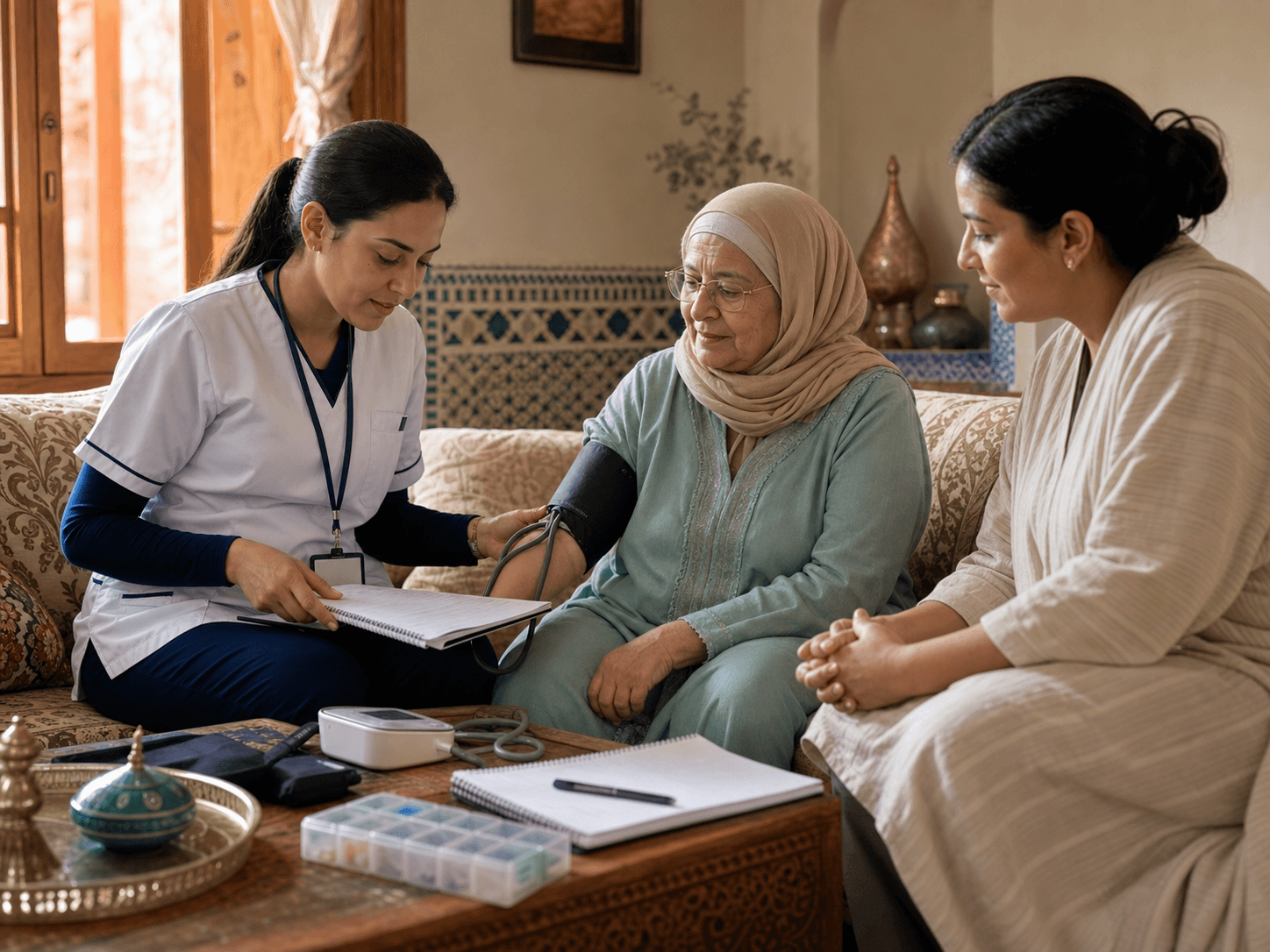
Administration of the treatment at the precise prescribed time, assessment of motor fluctuations (freezing episodes), help with mobility and everyday tasks, and monitoring of fall risk and general condition.
Visit frequency and monitoring
Visits adapted to the treatment regimen, sometimes several times a day to respect very strict dosing times, completed by support during physiotherapy sessions.
Coordination with your treating physician
Motor fluctuations, sleep disturbances and adverse effects are passed on to the neurologist. The adjustment of treatment is the physician's responsibility; the nurse ensures its precise application.
Equipment and home monitoring
Assessment and adaptation of the home (removal of obstacles, technical aids), monitoring of vital signs. On prescription, the nurse can manage the subcutaneous apomorphine pump.
The family's role between visits
We train relatives to strictly respect treatment timing, to prevent falls, to help with transfers and to support meals, which are often prolonged by swallowing difficulties.
AMO / CNSS coverage
Parkinson's disease falls under long-term illnesses (ALD). Nursing acts (AMI) are coded according to the NGAP and reimbursable by AMO/CNSS, with a compliant coded receipt and a signed care record.
Frequently asked questions
Yes. On the neurologist's prescription, our nurses are trained in the set-up, monitoring and maintenance of the subcutaneous apomorphine pump, as well as in the rotation of injection sites.
The effectiveness of L-Dopa depends on taking it at fixed times. A delay leads to freezing episodes, with immobility and tremors. Our nurses come at the prescribed time, even very early in the morning, to limit these fluctuations.
Yes. Parkinson's disease is a long-term illness (ALD); nursing acts (AMI) coded according to the NGAP are reimbursable by AMO/CNSS. We provide a compliant coded receipt and a signed care record.
Yes. Our carers support movement, encourage walking and balance exercises in coordination with the physiotherapist, and adapt the home to reduce the risk of falling.
The nurse assesses the home, flags obstacles, advises on adaptations and technical aids, and works on balance. In the event of a fall with injury, our private ambulance service can be mobilised and the physician alerted.
We train relatives in managing treatment timing, in safe transfers and in supporting meals, and we ensure, thanks to employed nurses, a reassuring continuity of follow-up.
Other conditions we treat
Parkinson's Home Care
Life-threatening emergency? Call SAMU 141.