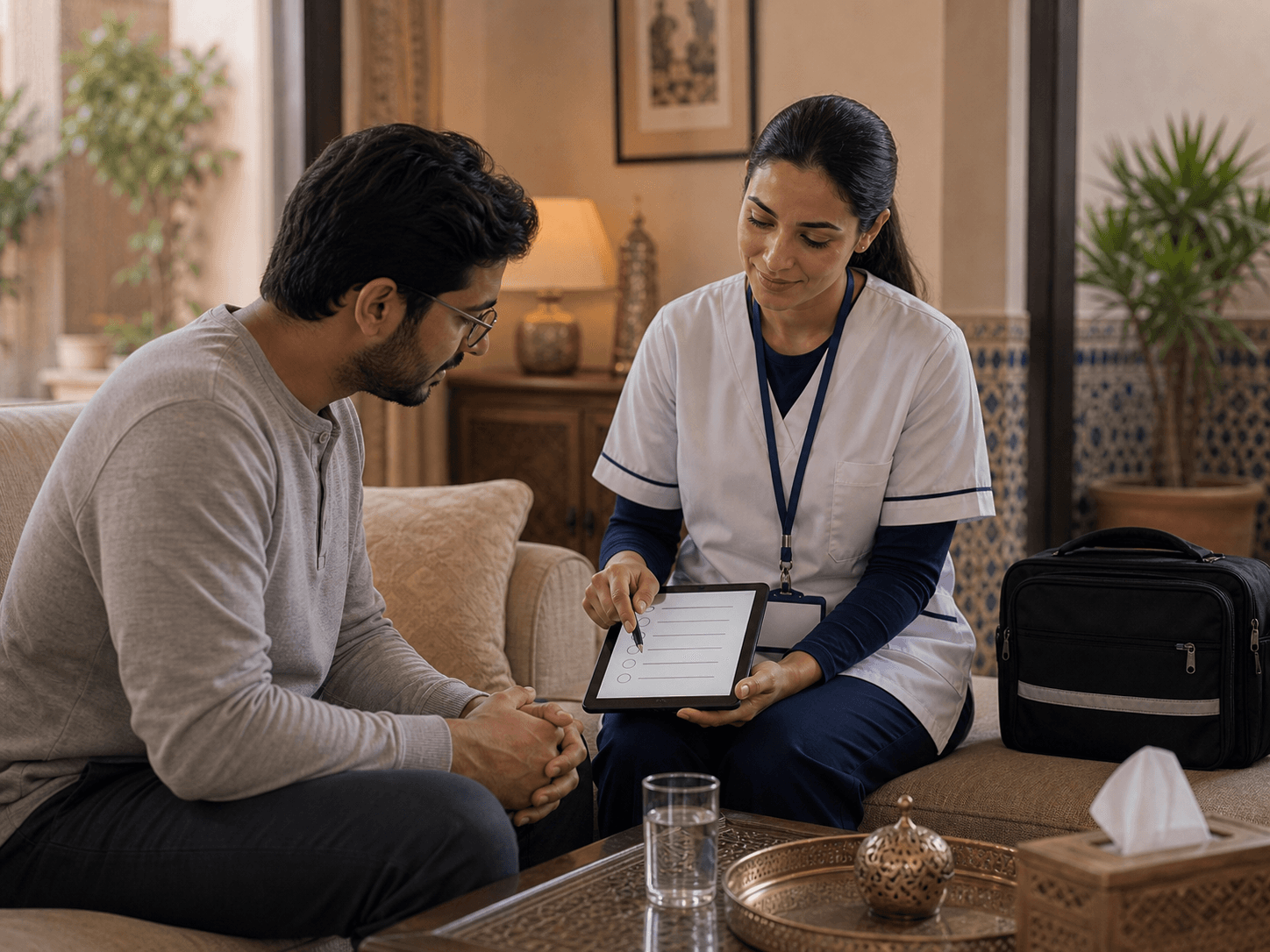
Home rehabilitation
After a fracture, stroke or surgery, regain your mobility at home.
30+
Qualified nurses
< 60min
Response time
24/7
Availability
22
Coverage zones
What this care involves
Motor and functional rehabilitation sessions at home, with progressive goals and a report sent to the prescribing doctor.
What's included
- Assessment of mobility, strength and balance
- Guided exercises towards agreed goals
- Joint mobilisation and gait re-education
- Adapting the home to prevent falls
- Progress report to the prescribing doctor
What to expect
Functional assessment
The nurse evaluates your mobility, muscle strength, balance and pain level. A rehabilitation programme tailored to your home is drawn up.
Guided exercises
Passive then active mobilisation, balance exercises, progressive muscle strengthening. Each session adapts to your progress and energy level.
Restoring independence
Bed-to-chair transfers, walking with and then without a frame, stair climbing. The goal is to regain autonomy in everyday movements.
Progress tracking
Improvements are documented at every visit and shared with your doctor and physiotherapist to adjust the programme.
The benefits
Rehab without the round trips
Your physiotherapist comes to you, sparing a painful journey after a fracture, stroke or operation when getting out is the hardest part.
A programme that follows your progress
Goals are set with you and raised step by step as you improve, so each session builds on the last instead of standing still.
Regain real independence
Walking, stairs and everyday movements are practised in the very place you use them, which makes the gains stick.
Who is this for
After a fracture or stroke
You have lost mobility following an accident or neurological event and need to gradually recover your functional abilities.
Hip or knee replacement
Post-surgical rehabilitation requires daily supervised exercises to restore normal joint range of motion.
Elderly person after prolonged bed rest
A long hospital stay has caused muscle loss and poor balance. Home rehabilitation prevents falls and speeds recovery.
Five steps, zero grey areas.
From first contact to the final report, every moment is documented, traceable and transparent.
- 01
You make a request
By phone, WhatsApp or via the platform. Describe the situation: a coordinator takes over immediately.
Response in under 15 minutes - 02
Clinical triage
The coordinator assesses the situation in 90 seconds: SAMU 141 if life-threatening, an SOS nurse if urgent, or a same-day scheduled visit.
Professional clinical assessment - 03
Nurse assignment
The nearest qualified nurse receives the offer. 60 seconds to respond, otherwise the next one is alerted automatically.
Every nurse verified individually - 04
The visit
The nurse arrives, identity verified. Vital signs entered on tablet, procedures documented, record signed.
Verified identity + real-time tracking - 05
After the visit
Report sent to your treating doctor. Vital signs available as PDF. NGAP-coded receipt for your AMO/CNSS claims.
Complete documentation within 24h
Clinical details
Home rehabilitation complements the physiotherapist's work through daily nursing support focused on functional recovery. The initial assessment evaluates muscle strength (manual muscle testing), joint range of motion (simplified goniometry), balance (Romberg test, single-leg stance) and fall risk. The programme follows a three-phase progression: passive mobilisation and anti-stiffness work (day 1–14), assisted active mobilisation and isometric exercises (day 14–30), then muscle strengthening and effort retraining (beyond day 30). Each session integrates pain management and prevention of thromboembolic complications. Functional goals are defined with the patient: resuming walking, climbing stairs, dressing independently. Progress is measured using standardised tests (Timed Up and Go, 6-minute walk test) and shared with the multidisciplinary team.
Frequently asked questions
Yes, home rehabilitation is carried out on a medical prescription that sets the diagnosis and number of sessions. We work to that plan and report progress back to the prescriber.
Most programmes run 2 to 5 sessions a week depending on your condition and goals. The physiotherapist reviews this regularly and tapers the frequency as you recover.
Yes. Our physiotherapists handle motor and functional rehabilitation for fractures, post-surgical recovery and neurological cases such as stroke, adapting the exercises to your abilities.
After my hip fracture, I thought I would never walk properly again. In two months of rehab at home, I'm climbing the stairs on my own. The nurse never let me give up.
Khadija R.
Patient — Bab Doukkala
Areas covered
- Guéliz< 20m
- Hivernage< 20m
- Semlalia< 25m
- Camp El Ghoul< 25m
- Médina< 25m
- Mellah< 25m
- Kasbah< 25m
- Bab Doukkala< 30m
- Palmeraie< 35m
- Sidi Ghanem< 35m
- Targa< 30m
- Ménara · Agdal< 30m
- Massira< 25m
- Daoudiate< 25m
- M'hamid< 30m
- Hay Al Izdihar< 30m
- Hay Mohammadi< 30m
- Sidi Youssef Ben Ali< 30m
- Chrifia · Route de l'Ourika< 35m
- Route de Safi< 35m
- Aïn Itti< 30m
- Tameslohte< 40m
Conditions we treat
Home rehabilitation
Life-threatening emergency? Call SAMU 141.