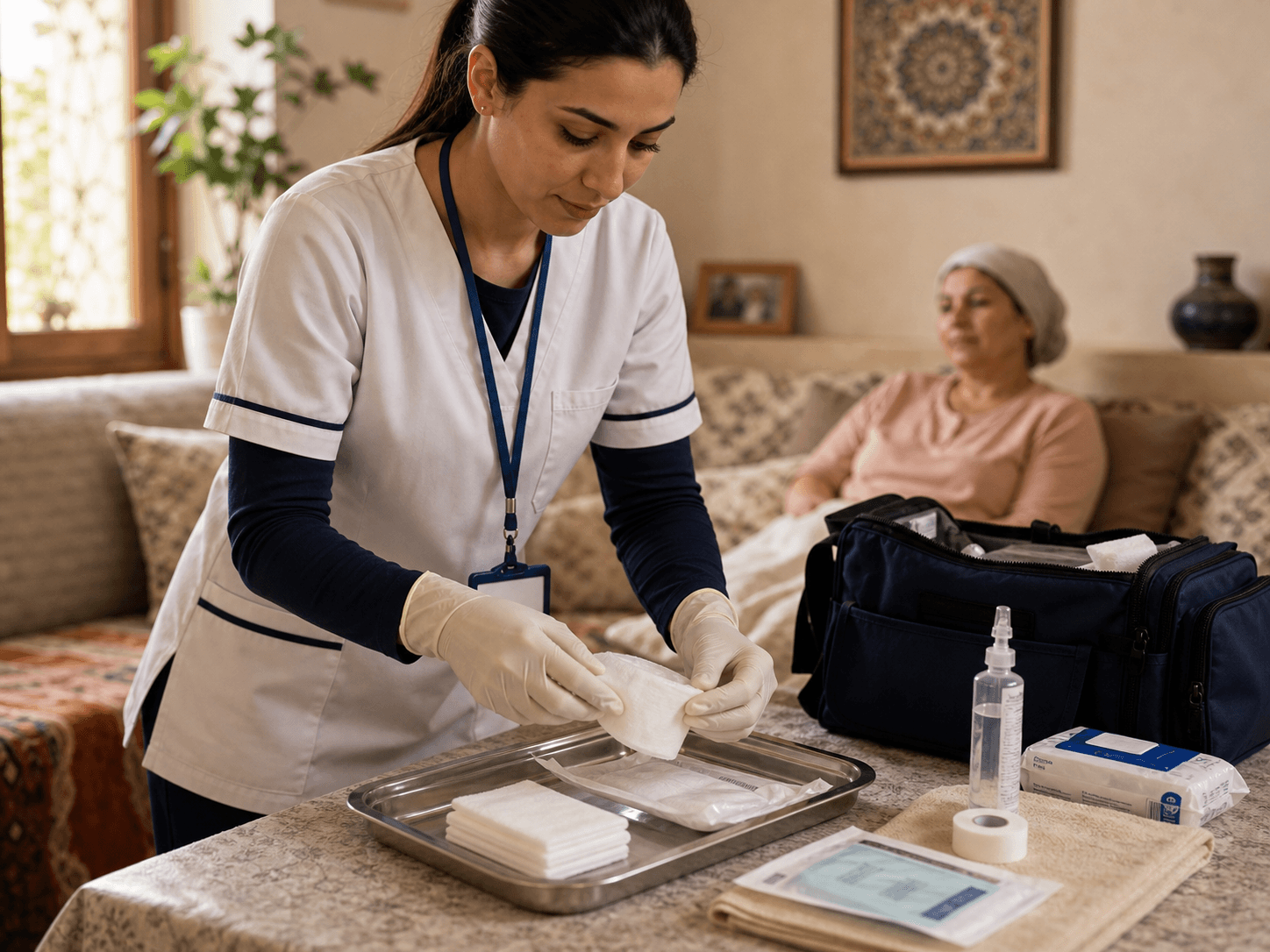
Wound care
Assessment, photo follow-up and a healing plan by specialist nurses.
30+
Qualified nurses
< 60min
Response time
24/7
Availability
22
Coverage zones
What this care involves
Wound assessment, cleansing, suitable dressing, follow-up photographs and a documented healing plan at every visit.
What's included
- Assessment and photograph of the wound
- Cleansing and antisepsis
- Selection of the right dressing
- Watching for signs of infection
- Updated healing plan and handover
What to expect
Wound assessment
The nurse measures the wound (length, depth, undermining), evaluates the healing stage, checks for signs of infection and selects the appropriate dressing protocol.
Cleansing and debridement
Saline wash, mechanical debridement if needed, removal of necrotic tissue. The wound bed is prepared to receive the optimal dressing.
Technical dressing
Depending on the wound type: hydrocolloid, alginate, hydrogel, foam, interface or negative-pressure dressing. The choice follows the protocol agreed with the doctor.
Photographic follow-up
Each dressing change is documented with a time-stamped photograph. The healing progress is sent to the prescribing doctor for protocol adjustments.
The benefits
Wounds that finally heal
A specialist nurse follows the right protocol for an ulcer, pressure sore or chronic wound, so healing moves forward instead of stalling.
Progress you can see
Follow-up photographs at each visit show whether the wound is improving, and guide a change of dressing the moment one is needed.
Complications headed off
Early signs of infection or deterioration are caught and reported, sparing you a return to hospital.
Who is this for
Pressure sores or venous ulcers
You or your loved one has a chronic wound requiring specialist dressings and rigorous healing follow-up.
Complicated post-operative wound
Your incision is not healing as expected: redness, discharge, dehiscence. Daily nursing follow-up is essential.
Burn or traumatic wound
You have an extensive wound that needs regular sterile care and monitoring for bacterial colonisation.
Five steps, zero grey areas.
From first contact to the final report, every moment is documented, traceable and transparent.
- 01
You make a request
By phone, WhatsApp or via the platform. Describe the situation: a coordinator takes over immediately.
Response in under 15 minutes - 02
Clinical triage
The coordinator assesses the situation in 90 seconds: SAMU 141 if life-threatening, an SOS nurse if urgent, or a same-day scheduled visit.
Professional clinical assessment - 03
Nurse assignment
The nearest qualified nurse receives the offer. 60 seconds to respond, otherwise the next one is alerted automatically.
Every nurse verified individually - 04
The visit
The nurse arrives, identity verified. Vital signs entered on tablet, procedures documented, record signed.
Verified identity + real-time tracking - 05
After the visit
Report sent to your treating doctor. Vital signs available as PDF. NGAP-coded receipt for your AMO/CNSS claims.
Complete documentation within 24h
Clinical details
Home wound care follows HAS and SFFPC (Société Française et Francophone des Plaies et Cicatrisations) best-practice guidelines. Initial assessment uses the colour scale (black, yellow, red, pink) and surface measurement (ruler or tracing) to objectify progress. Dressing selection follows the TIME principle (Tissue, Infection, Moisture, Edge): debridement of necrotic tissue, bacterial-load control, maintenance of an optimal moist environment and stimulation of wound edges. Modern dressings (alginates, hydrogels, foams, negative-pressure therapy) are chosen according to the healing stage. Monitoring includes screening for local infection signs (redness, warmth, pain, purulent discharge) and systemic signs (fever, raised CRP). Any anomaly is reported to the prescribing doctor with photographic documentation for objective remote follow-up.
Frequently asked questions
Typically 2 to 3 times a week, though an infected or heavily exuding wound may need daily care. The nurse sets the rhythm from the wound’s appearance and the dressing used.
Dated photographs create an objective record of healing, let several professionals follow the same case and help your doctor decide on changes without re-examining you in person.
Prescribed dressings are listed nursing acts that AMO and CNSS can reimburse. We provide an itemised invoice referencing the prescription so you can file your claim.
My sacral pressure sore had not healed in four months. The nurse changed the dressing protocol, came every other day, and in six weeks the wound was closed.
Abdelkrim S.
Patient, stage III pressure sore — Mellah
Areas covered
- Guéliz< 20m
- Hivernage< 20m
- Semlalia< 25m
- Camp El Ghoul< 25m
- Médina< 25m
- Mellah< 25m
- Kasbah< 25m
- Bab Doukkala< 30m
- Palmeraie< 35m
- Sidi Ghanem< 35m
- Targa< 30m
- Ménara · Agdal< 30m
- Massira< 25m
- Daoudiate< 25m
- M'hamid< 30m
- Hay Al Izdihar< 30m
- Hay Mohammadi< 30m
- Sidi Youssef Ben Ali< 30m
- Chrifia · Route de l'Ourika< 35m
- Route de Safi< 35m
- Aïn Itti< 30m
- Tameslohte< 40m
Conditions we treat
Wound care
Life-threatening emergency? Call SAMU 141.