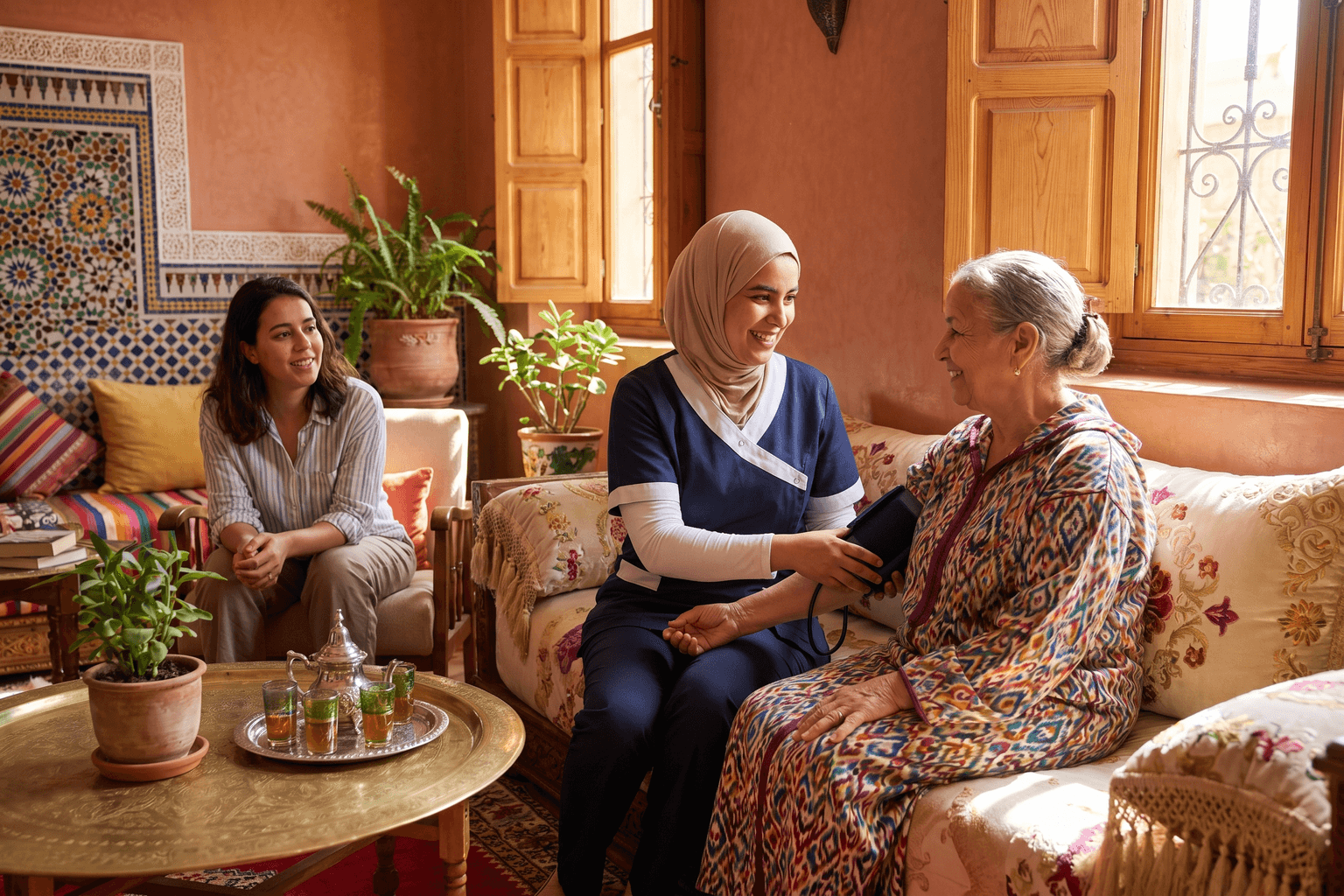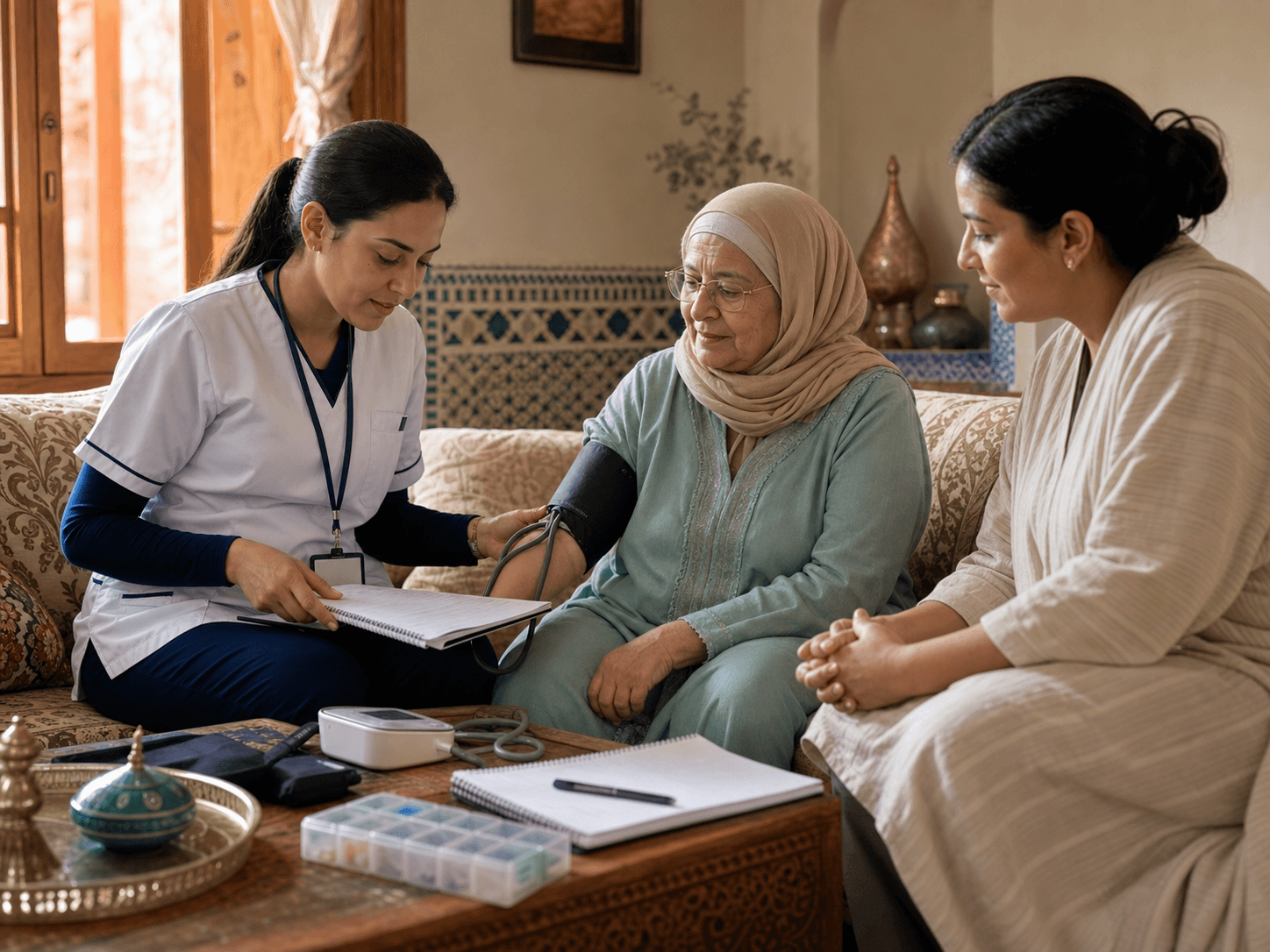
Night-time is often the most anxious period for families caring for a frail, ill, or dependent relative. Falls, disorientation, repeated needs, treatment monitoring: providing a nocturnal presence exhausts family carers. A night carer at home offers a valuable solution. In Marrakech, SOS Nursing provides night care ranging from simple companionship to medical-level monitoring by a state-certified nurse.
A night carer is a professional who stays at the home overnight to watch over a vulnerable person.
What a night carer does
A night carer is a professional who stays at the home overnight to watch over a vulnerable person. Their role varies according to need: providing a reassuring presence, helping with night-time movement, preventing falls, assisting with bathroom trips, monitoring sleep, and alerting the family if a problem arises. For situations with greater medical complexity, a nurse takes on the night shift — administering treatments and monitoring vital signs. This continuous presence, where the family can no longer manage alone through entire nights, keeps the relative safe and allows carers to get the restorative sleep their own health depends on.
Night carer vs. nurse: what is the difference
Two levels of service must be distinguished. A home care aide or care assistant provides companionship, emotional support, and help with daily activities: movement, changing, hydration, and general monitoring. They do not perform medical acts. A state-certified nurse, on the other hand, carries out technical care: administering treatments, injections, monitoring vital signs, and managing a catheter or infusion. The choice depends on the relative's condition. A disoriented but medically stable person usually needs a care aide; a patient on complex treatment or in palliative care requires nursing-level expertise. SOS Nursing assesses the situation to recommend the right option.
Who benefits from a night carer
Several profiles benefit from overnight care. Elderly people with cognitive impairment — such as Alzheimer's disease — who get up, wander, or become agitated at night. Patients recently discharged from hospital who need close monitoring. Individuals at high risk of falls after a fracture or stroke. Patients in palliative care who require company and pain control. And exhausted family carers who need respite to keep going. In all these situations, night-time concentrates both risk and anxiety: a professional presence brings security and relief.
Night-time monitoring and fall prevention
Fall risk is greatest at night: darkness, disorientation on waking, bathroom trips, and medications that reduce alertness all play a role. The carer ensures a safe environment, accompanies every movement, and anticipates needs to prevent rushed rising. They monitor sleep, detect agitation, pain, breathing difficulty, or unusual confusion, and raise the alarm if necessary. For disoriented individuals, their presence soothes the nocturnal anxiety that is common in dementia. This constant vigilance prevents accidents that, occurring alone at night, might go unattended for hours with serious consequences.
Supporting the family carer
Behind every dependent relative, there is often a family carer running on empty. Managing nights on top of days leads to burnout and sometimes illness. A night carer is not a luxury: it is as much a measure of protection for the carer as for the patient. Being able to sleep through the night, leave with a clear conscience, or simply take a few hours' break makes it possible to keep going and to continue supporting a loved one with patience. Recognising one's limits is not abandonment — it is the condition for lasting the distance. SOS Nursing helps families preserve this balance.
How a typical night unfolds
A night shift is organised around clear reference points. On arrival, the professional reviews the instructions, treatments, and habits of the relative. They provide monitoring, accompany any wakeful periods, administer scheduled treatments if they are a nurse, and note overnight events. In the morning, they hand over a report to the family or day team: sleep quality, incidents, pain, medication given. This handover ensures continuity of care. Hours are adapted to needs, typically evening to morning. The family defines the exact scope of the assignment with the coordinator, so that no expectation remains unspoken.
Choosing the right option
Several factors guide the choice. Whether needs are medical or not determines whether a care aide or nurse is required. Frequency varies: a one-off night for respite, a few nights per week, or daily presence for a complex situation. The duration depends on how the relative's condition evolves. SOS Nursing assesses the situation with the family, proposes a suitable arrangement, and adjusts it over time. Because our professionals are salaried, continuity and reliability are assured, with the same team members wherever possible — providing the familiar faces that matter so much to a vulnerable person.
SOS Nursing's organisation
SOS Nursing structures night care around a single, reachable coordinator who manages schedules and ensures continuity. Depending on need, the assignment goes to a care aide or a state-certified nurse — always trained and supervised. Overnight reports maintain follow-up and the link with the physician. Our model, built on salaried professionals rather than one-off matching, guarantees reliability and consistent quality over time. For families in Marrakech, this means a serious overnight presence that protects their vulnerable relative while giving carers the rest they need.