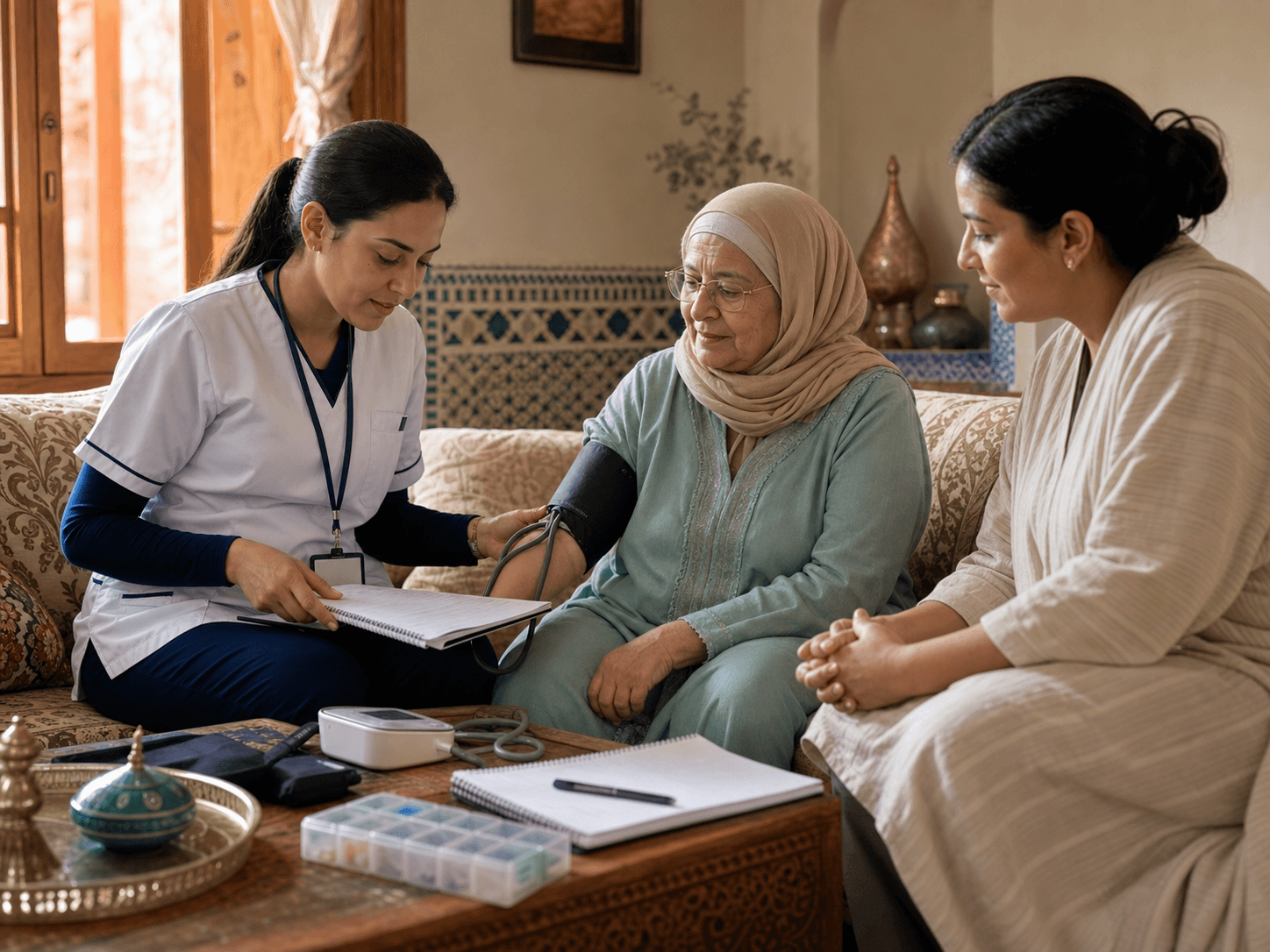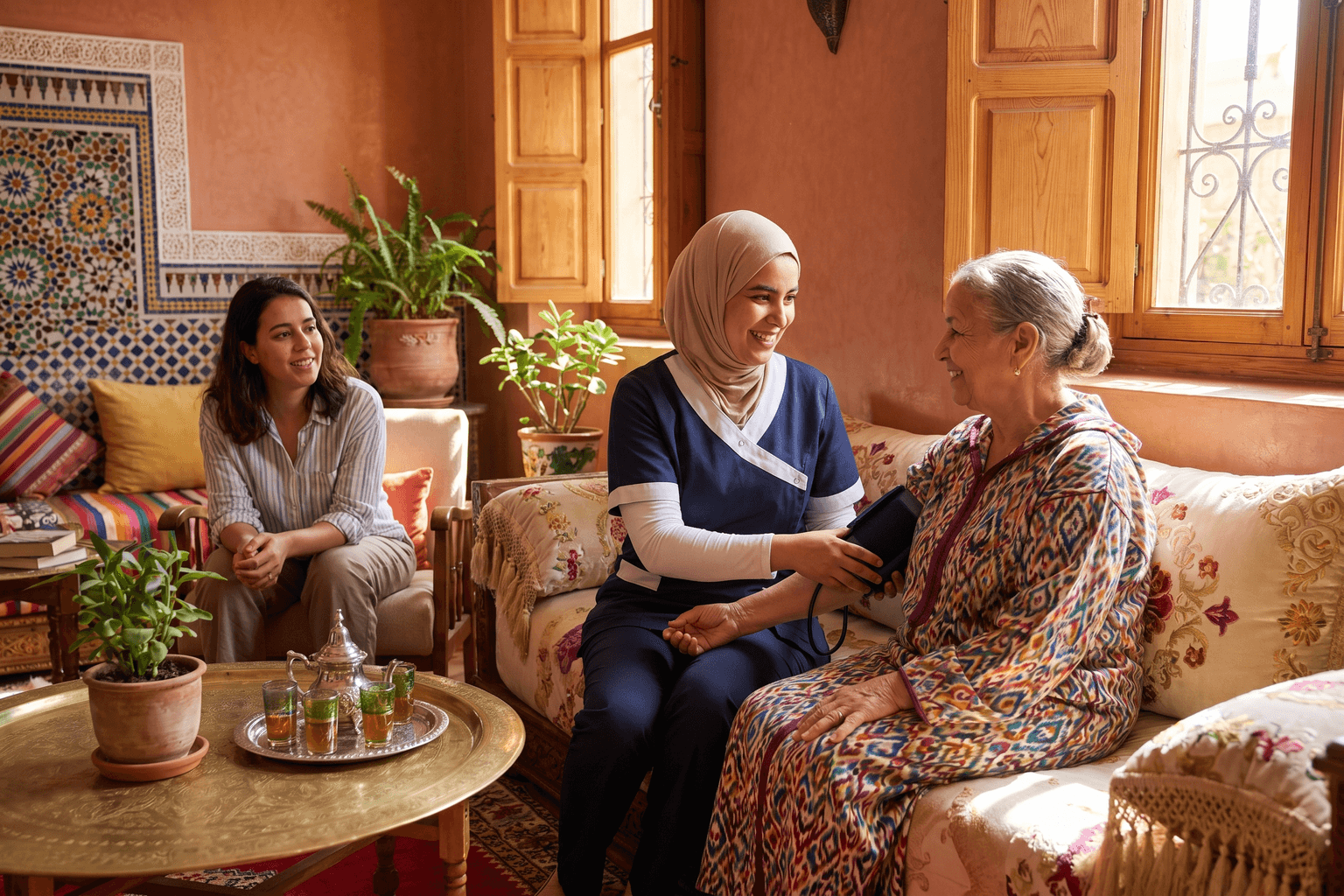
Choosing a home nurse is an important decision that affects the health and safety of your loved one. In Marrakech, the offer is varied but quality is uneven. Here are the criteria you must verify.
When a loved one needs care at home, it is tempting to compare providers on price alone, but home nursing is one area where the cheapest option can be the most expensive…
Why the choice matters more than the price
When a loved one needs care at home, it is tempting to compare providers on price alone, but home nursing is one area where the cheapest option can be the most expensive mistake. The person you choose will administer medication, manage wounds or injections, and step into the most private corners of your family's life, often when your relative is at their most vulnerable. A poorly qualified or unsupervised carer can miss a deteriorating condition, give a medication incorrectly, or simply fail to turn up when it matters. The criteria below are the ones that genuinely protect your relative, and they are also the ones that distinguish a properly managed service from an informal arrangement found by word of mouth.
Verify the State Nursing Diploma
The single most important check is qualification. In Morocco, nursing acts must be performed by a holder of the State Nursing Diploma (Diplôme d'État d'Infirmier) issued by a school recognised by the Ministry of Health. Be especially wary of care assistants or aides who present themselves as nurses; they may be kind and well-meaning, but they are not trained or authorised to perform injections, manage complex medication, or handle a clinical emergency. Always ask to see the diploma and confirm the professional's registration. SOS Nursing systematically verifies every nurse's diploma and registration before they ever see a patient, so families do not have to perform this check themselves or take anyone's word for it.
Check professional liability insurance (RC Pro)
Every nurse providing care should be covered by Professional Liability Insurance, known in Morocco as RC Pro. This matters because even with the best practice, care carries risk, and if something goes wrong during a procedure, this insurance protects both the patient and the professional, ensuring that any harm can be properly addressed. An uninsured independent carer leaves your family exposed with no recourse. With an informal hire it can be impossible to confirm whether insurance exists at all. A managed service removes this worry: SOS Nursing covers all of its nurses under a collective RC Pro policy, so every patient is protected as a matter of course, with no paperwork for the family to chase.
Assess experience and the right specialisation
A diploma confirms competence, but experience and fit determine quality. A nurse who is excellent at post-operative wound care may not be the ideal match for a patient with advanced dementia, complex diabetes, or palliative needs. Ask about the kinds of cases a provider handles regularly and whether they can match a nurse to your relative's specific condition. Continuity matters too: being able to keep the same nurse, who comes to know your relative's history, preferences and baseline, makes care safer and more reassuring. Because SOS Nursing employs its nurses directly rather than acting as a marketplace, it can assign the right professional to each case and maintain that continuity over time.
Insist on medical coordination
A good home nurse never works in isolation. They communicate with the attending physician, keep clear written records of each visit, and raise the alarm promptly when a patient's condition changes or a complication appears. This coordination is what turns a series of individual visits into genuine, joined-up care, and it is often missing in informal arrangements where a lone carer has no one to escalate to. Ask how a provider documents care and who is reachable if something happens between visits. SOS Nursing structures this through a team of coordinators reachable around the clock, so the nurse, the doctor and the family all stay connected and no warning sign goes unreported.
Respect for privacy and data protection
A home nurse enters the intimacy of your household and handles sensitive health information, so professionalism here is non-negotiable. The nurse must respect medical confidentiality, protect your relative's modesty and dignity during personal care, and handle personal and health data in accordance with Moroccan data-protection law (Law 09-08, overseen by the CNDP). Ask whether a provider has a clear data-protection policy and how patient records are stored and shared. This is an area where reputable, structured providers stand apart from informal carers who keep no proper records and offer no guarantees about confidentiality.
Reliability, availability and backup cover
Care is only as good as its dependability. A single independent nurse, however skilled, falls ill, takes holidays and cannot be in two places at once, which means a missed visit can leave a dependent patient without essential medication or a vital dressing change. Before committing, ask what happens when the usual nurse is unavailable, how quickly a replacement can be arranged, and whether urgent needs are covered at night and at weekends. This is one of the clearest advantages of a managed service over a solo hire: SOS Nursing can provide backup cover from its own team, arrange around-the-clock availability for emergencies, and ensure that a patient's care plan continues uninterrupted whatever happens.
Questions to ask before you commit
A short, direct conversation reveals a great deal. Ask to see the State Nursing Diploma and proof of RC Pro insurance; ask how the provider coordinates with your doctor and documents each visit; ask whether you can request a male or female nurse and keep the same person over time; ask what happens if your usual nurse is unavailable, and how quickly care can start. Ask too how the provider handles your relative's personal data, and whether procedures can be reimbursed through AMO or CNSS. A trustworthy provider will answer all of these openly and put them in writing. Vague or evasive answers are a warning sign worth heeding before any care begins.