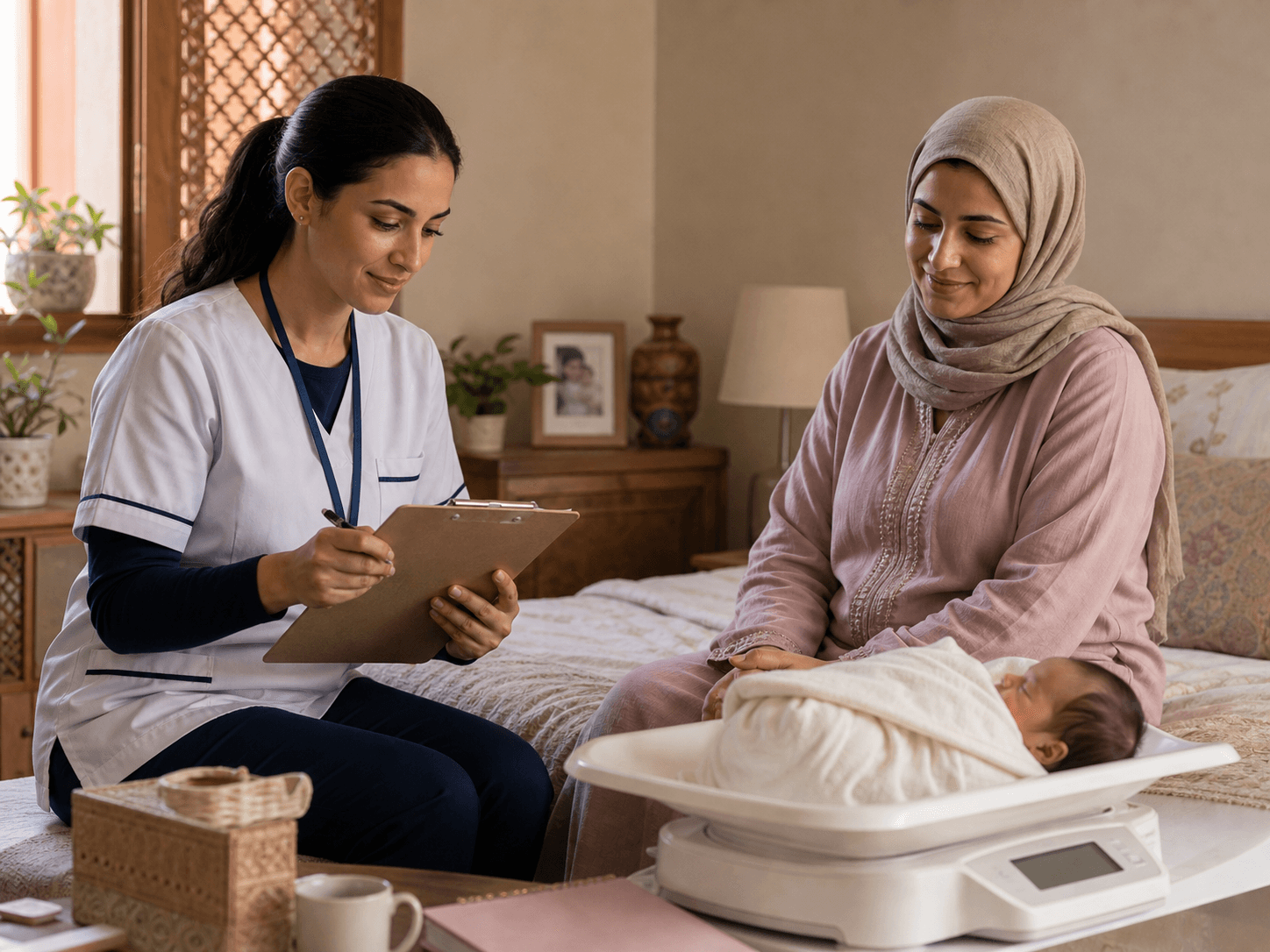
Postpartum & newborn care
Breastfeeding, newborn care and follow-up for mum, at home.
30+
Qualified nurses
< 60min
Response time
24/7
Availability
22
Coverage zones
What this care involves
Breastfeeding support, cord and newborn care, monitoring of healing and of mum's wellbeing after the birth.
What's included
- Breastfeeding and latch support
- Cord care and newborn hygiene
- Newborn weight and jaundice check
- Review of mum’s healing and bleeding
- Guidance on sleep, feeding and warning signs
What to expect
Post-delivery visit
The nurse assesses your general condition (wound, bleeding, pain), checks your vital signs and makes sure breastfeeding is getting off to a good start.
Newborn care
Bath, umbilical cord care, weighing, temperature and skin-colour check. The nurse watches for signs of jaundice or dehydration.
Breastfeeding support
Position, latch, feed frequency, managing sore nipples: practical and emotional support so breastfeeding goes as smoothly as possible.
Guidance and reassurance
Baby's sleep rhythm, colic, caesarean wound care: the nurse answers every new-parent question calmly and thoroughly.
The benefits
Confident first days at home
A midwife comes to you so you are not navigating feeds, the cord and a tiny newborn alone in the overwhelming first week.
Mum is looked after too
We check your recovery, whether after a vaginal birth or caesarean, and watch for signs that need a doctor, not just the baby.
Real answers, in your home
Every worried question about latch, weight or sleep is answered calmly at your bedside, with practical help rather than a rushed clinic visit.
Who is this for
First baby
This is your first child and you feel overwhelmed by feeds, cord care and crying. Professional guidance makes all the difference.
Recent caesarean
Your mobility is limited by the surgery and you need help with baby care, bathing and your own early recovery.
No close family support
Your family is far away or unavailable and you need a professional to help you through the first weeks with confidence.
Five steps, zero grey areas.
From first contact to the final report, every moment is documented, traceable and transparent.
- 01
You make a request
By phone, WhatsApp or via the platform. Describe the situation: a coordinator takes over immediately.
Response in under 15 minutes - 02
Clinical triage
The coordinator assesses the situation in 90 seconds: SAMU 141 if life-threatening, an SOS nurse if urgent, or a same-day scheduled visit.
Professional clinical assessment - 03
Nurse assignment
The nearest qualified nurse receives the offer. 60 seconds to respond, otherwise the next one is alerted automatically.
Every nurse verified individually - 04
The visit
The nurse arrives, identity verified. Vital signs entered on tablet, procedures documented, record signed.
Verified identity + real-time tracking - 05
After the visit
Report sent to your treating doctor. Vital signs available as PDF. NGAP-coded receipt for your AMO/CNSS claims.
Complete documentation within 24h
Clinical details
Postpartum home care covers the maternal and neonatal monitoring recommended by the WHO for the first 6 weeks. Maternal: assessment of uterine involution, lochia monitoring, wound inspection (perineal or caesarean), screening for signs of venous thrombosis and evaluation of postnatal depression risk (EPDS score). Neonatal: weight curve (physiological loss under 10 % of birth weight, regained by day 14), neonatal jaundice monitoring (skin inspection, referral for bilirubin testing if needed), umbilical cord care (antisepsis, stump monitoring), and verification of sucking and swallowing. Breastfeeding support follows WHO and La Leche League recommendations: early skin-to-skin, feeding on demand, weight-gain monitoring and management of complications (engorgement, cracked nipples, mastitis).
Frequently asked questions
Ideally within the first two or three days after you come home, when feeding and cord care questions peak. Visits are then spaced out over the following weeks as you and your baby find your rhythm.
Yes. A perinatal nurse or midwife assesses the latch, position and milk supply, treats sore or cracked nipples and supports mixed feeding if that is your choice, without judgement.
We care for both of you: newborn checks and feeding support, plus monitoring of your caesarean wound, pain and recovery, with referral to your doctor if anything concerns us.
After my caesarean I couldn't even lift my baby on my own. The nurse showed me how to bathe him, breastfeed and care for my wound. Without her, those first days would have been terrifying.
Sara K.
New mother — Gueliz
Areas covered
- Guéliz< 20m
- Hivernage< 20m
- Semlalia< 25m
- Camp El Ghoul< 25m
- Médina< 25m
- Mellah< 25m
- Kasbah< 25m
- Bab Doukkala< 30m
- Palmeraie< 35m
- Sidi Ghanem< 35m
- Targa< 30m
- Ménara · Agdal< 30m
- Massira< 25m
- Daoudiate< 25m
- M'hamid< 30m
- Hay Al Izdihar< 30m
- Hay Mohammadi< 30m
- Sidi Youssef Ben Ali< 30m
- Chrifia · Route de l'Ourika< 35m
- Route de Safi< 35m
- Aïn Itti< 30m
- Tameslohte< 40m
Postpartum & newborn care
Life-threatening emergency? Call SAMU 141.