A home blood test lets you have your analyses done without going out: a state-registered nurse comes to your home, hotel, or office, and the samples are analysed by an accredited partner laboratory. It is a solution particularly suited to elderly people, those with reduced mobility, children, very busy people, and travellers, who benefit from the same standards of hygiene and reliability as in a laboratory. Digital results generally arrive within 24 to 48 hours depending on the analyses, transmitted securely and confidentially. This guide details the full process, from booking to result, the preparation required (fasting), the analyses that can be carried out, indicative prices, and the conditions for reliability. You will also find concrete answers to the most frequent questions from Marrakesh patients.
The process is simple and quick.
How a home blood test works
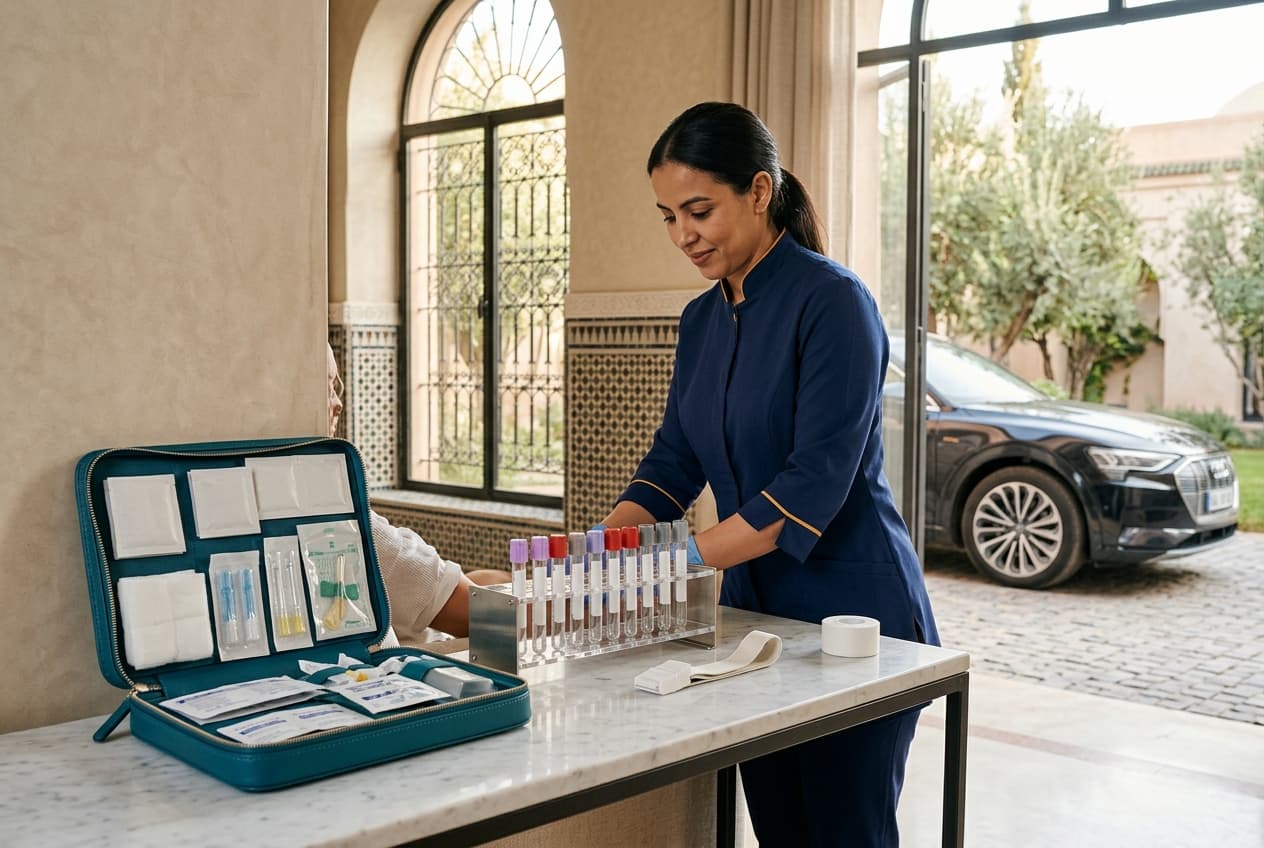
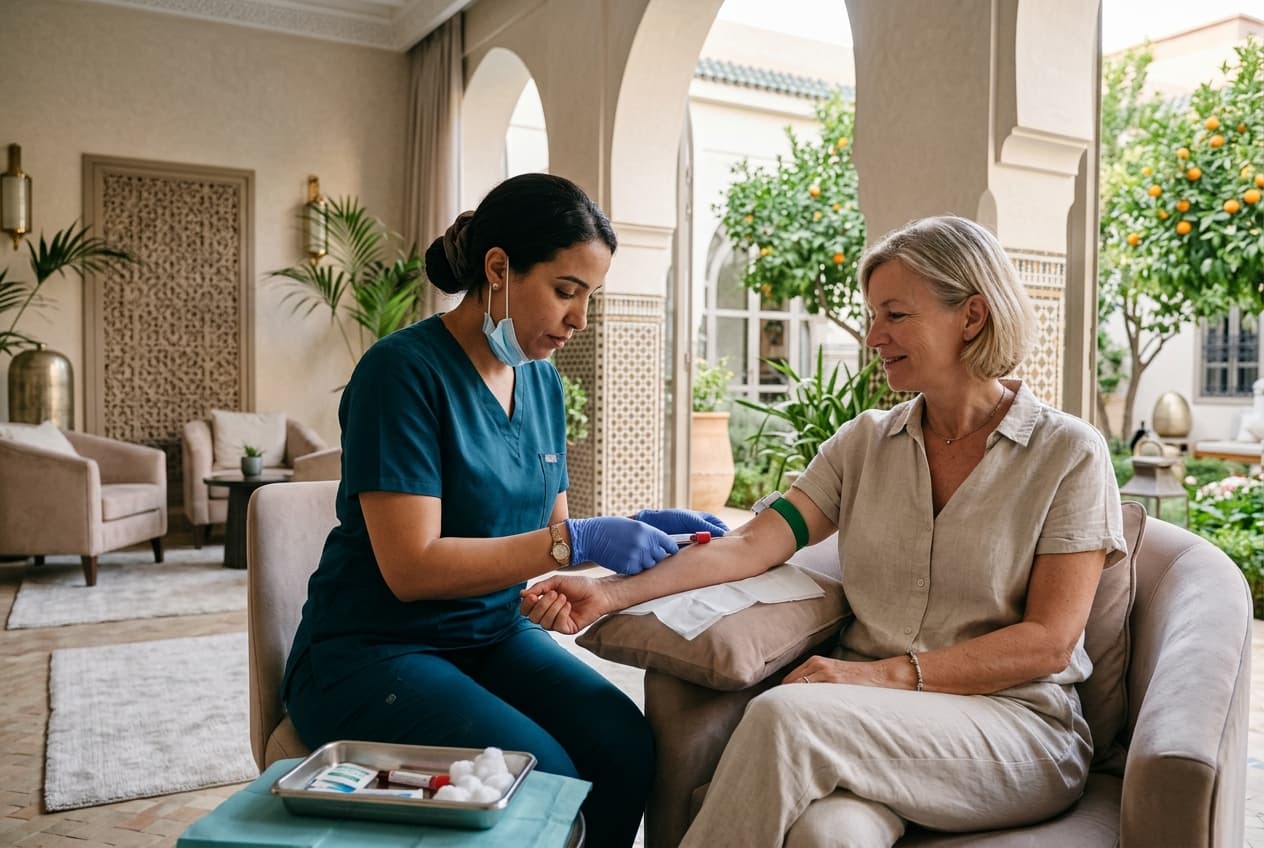
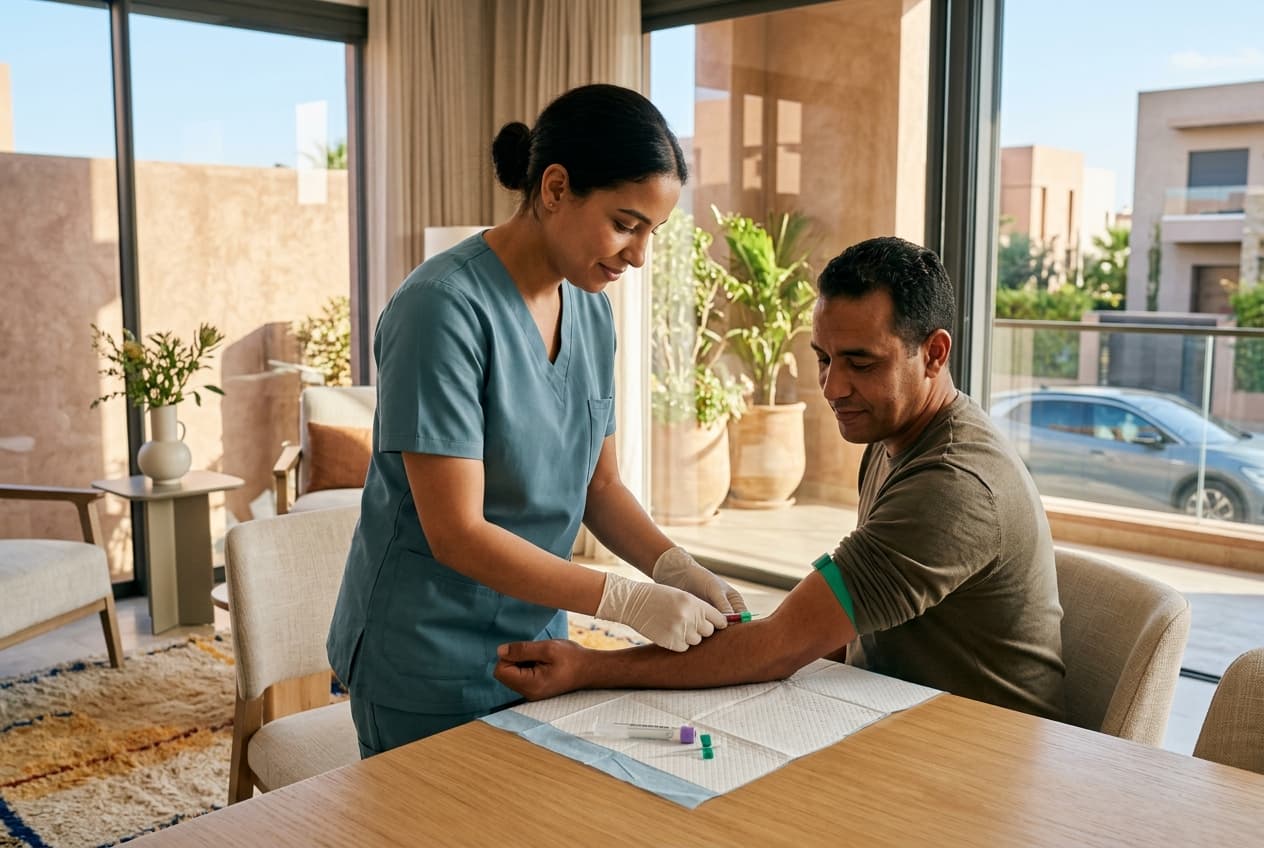
The process is simple and quick. You book by WhatsApp, telephone, or online, specifying the prescribed analyses and your neighbourhood; a state-registered nurse travels to the agreed slot with sterile, single-use equipment. On site, the nurse checks your identity and the prescription, applies a tourniquet, disinfects the puncture site, and takes the sample, which lasts only a few minutes. The tubes are immediately labelled with your name, kept in the required conditions, and taken to the accredited partner laboratory. The results are then sent to you digitally. Throughout the procedure, asepsis and traceability are respected exactly as in a laboratory.
Do you need to fast?
Whether fasting is necessary depends on the analyses requested, and it is a frequent question. A lipid profile (total cholesterol, HDL, LDL, triglycerides) or a fasting blood glucose generally require 12 hours of fasting, while still water remains allowed. By contrast, glycated haemoglobin (HbA1c), many hormone assays, or a simple full blood count do not require fasting. Avoid alcohol the day before and intense physical effort on the morning of the sample, which can distort certain results. Continue your usual treatments unless your doctor advises otherwise, and tell the nurse about them. If in doubt, ask for the precise instruction at the time of booking: it is better to check than to have to repeat the sample.
Which analyses can be done at home
The great majority of routine analyses can be taken at home without difficulty. This includes the full blood count, blood glucose and HbA1c for diabetes, the lipid profile, the renal (urea, creatinine) and liver (transaminases) panels, the electrolyte panel, the thyroid panel (TSH, T3, T4), ferritin, vitamin D, inflammatory markers (CRP, ESR), coagulation panels, and many hormone assays. Certain specific tests require particular transport or temperature conditions, which the nurse takes into account. Urine samples and the provision of a urine-culture container can be arranged as well. If an analysis cannot be carried out at home for technical reasons, you will be told at the time of booking.
Price and travel charge
The price depends on the prescribed analyses, as in a laboratory. As a guide on the Marrakesh market, a full blood count costs around 80 DH and a complete profile more than 200 DH, to which a home-visit travel charge of about 50 to 150 DH is added depending on distance and time of day. The exact price, based on your prescription, is communicated before the visit, with no hidden charges. For a panel grouping several analyses, the cost per parameter stays contained since the travel is billed only once. Ask for a clear quote at the time of booking and keep the named invoice, useful for any reimbursement claim with your scheme or your mutual fund.
Turnaround and delivery of results
Digital results are generally available within 24 to 48 hours depending on the type of analysis, with certain specialised analyses sometimes taking a little longer. They are sent to you by WhatsApp, email, or via a secure patient portal, in a clear format usable by your doctor. The analyses are validated by the accredited partner laboratory, which guarantees reliability and compliance with standards. Your health data remains strictly confidential, in accordance with Moroccan personal-data protection regulations (CNDP). If a result falls outside the reference ranges, your doctor can interpret it in the context of your state of health; we can arrange a control sample if needed.
Hygiene, safety, and sample quality
The reliability of a home blood test rests on rigorous asepsis. The nurse uses exclusively sterile, single-use equipment (needles, tubes, swabs), carries out careful antisepsis of the skin, and disposes of sharps in a secure container. The order of tube filling, the mixing of tubes containing anticoagulant, and immediate labelling avoid pre-analytical errors. Respecting the cold chain for sensitive analyses and a fast transfer to the laboratory guarantee the integrity of the samples. These protocols, identical to those of a laboratory, explain why a home sample is just as reliable, provided it is carried out by a state-registered professional.
Who it is for
Home blood tests are for a wide public. They are ideal for elderly people and those with reduced mobility, for whom a trip to the laboratory is painful or risky, and for chronic patients (diabetes, anticoagulant treatment) who need regular checks. Children, who are often anxious, are sampled in the reassuring setting of home, with their parents beside them. Overstretched working people save precious time by avoiding the queue, and travellers in hotels or riads access a check or a certificate without knowing the city. Pregnant women and immunocompromised people also limit their exposure to waiting rooms. In every case, the quality of analysis is identical to that of the laboratory.