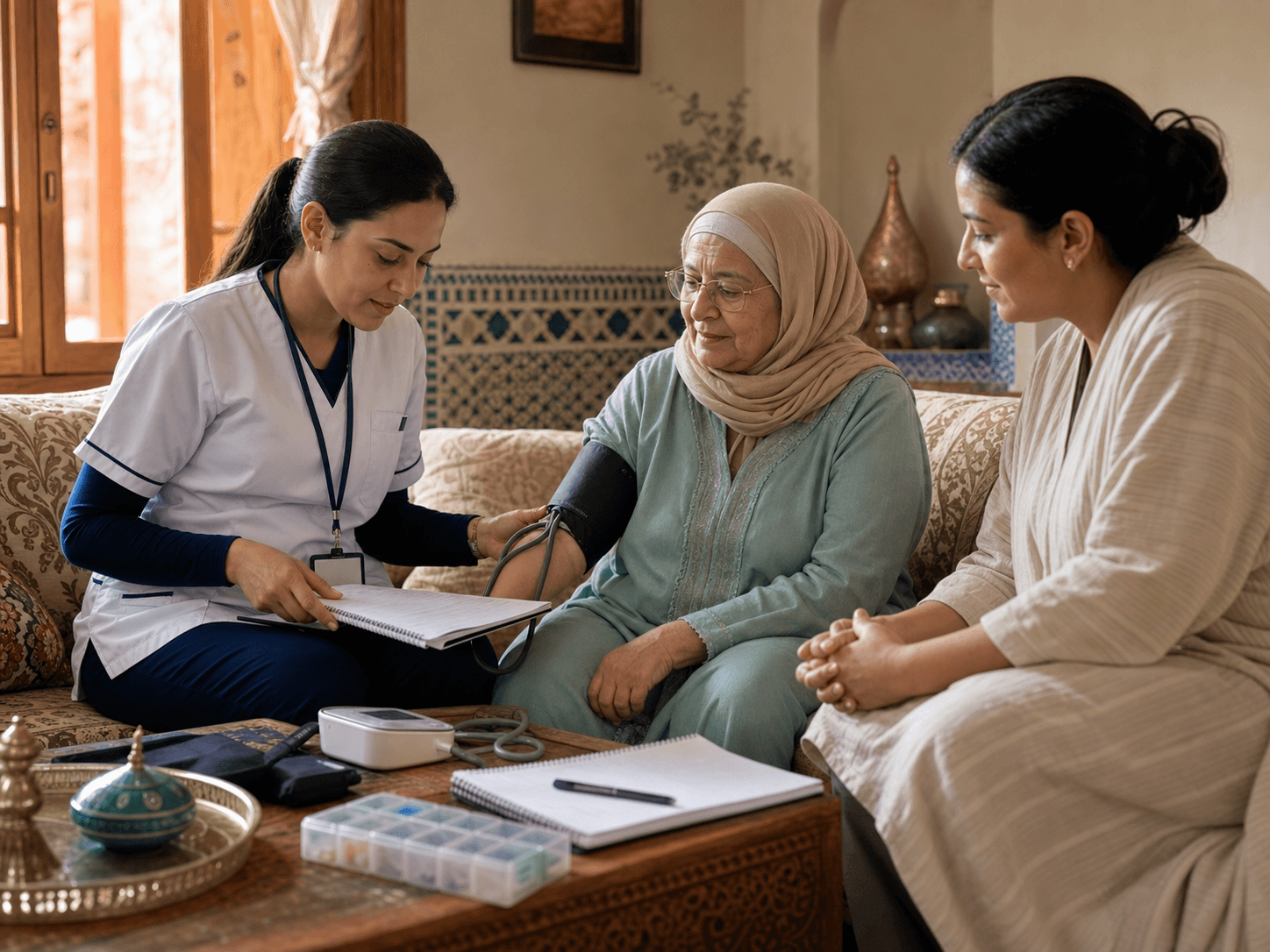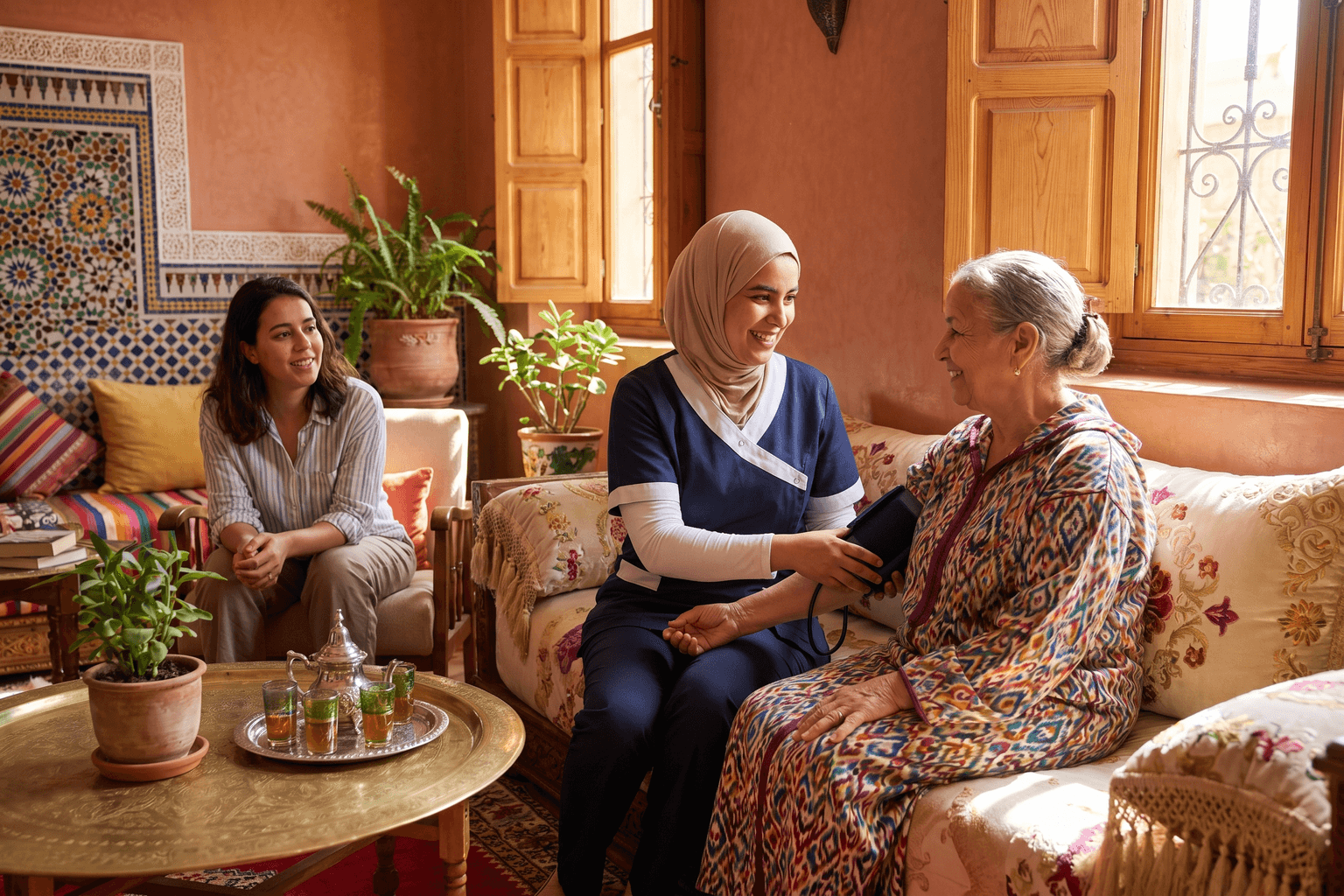
Cost concerns still prevent too many families from accessing home nursing care. Yet several schemes provide partial coverage in Morocco. Between the AMO (Assurance Maladie Obligatoire, Morocco's mandatory health insurance), CNSS, CNOPS, mutual insurance, and the schedule of medical acts, the system can seem complex. This guide clarifies who reimburses what, under what conditions, and how to build a strong claim to maximise reimbursement for your prescribed home nursing care.
The AMO forms the bedrock of health coverage in Morocco.
The AMO: the foundation of health coverage
The AMO forms the bedrock of health coverage in Morocco. Administered for private-sector employees by the CNSS and historically for the public sector by the CNOPS, it covers a portion of insured persons' and their dependants' healthcare costs. Prescribed nursing care can be eligible under certain conditions. However, the AMO never covers the full cost: a co-payment always remains, which mutual insurance can top up. Understanding how the AMO works is the first step in assessing what will be reimbursed and what will stay at your expense.
CNSS, CNOPS, and schemes by employment status
Reimbursement depends first on your scheme of affiliation. Private-sector employees fall under the CNSS; civil servants under the scheme historically administered by the CNOPS, now integrated into the broader AMO framework. Self-employed workers have had their own AMO scheme for several years. Each scheme has its own rates, ceilings, and procedures. Confirming your affiliation and entitlement is essential before starting any claim. A SOS Nursing coordinator can help you identify your scheme and the documents required, but it is your insurer that ultimately determines the exact amount covered.
The NGAP-style schedule and medical-nursing acts
Reimbursable nursing acts are codified according to a schedule modelled on the NGAP (French nomenclature of general-practice acts), which assigns each type of care a letter key and a coefficient. Medical-nursing acts, known as actes AMI, cover injections, dressings, infusions, monitoring, and other technical care on prescription. Reimbursement is calculated from this coefficient and the reference tariff, not the actual invoiced price. This is why the amount reimbursed may differ from the cost of the service. Requesting that acts be clearly itemised with their codes on supporting documents makes it easier for the insurer to process your claim and avoids rejections for imprecise coding.
The role of the medical prescription
No reimbursement of nursing care is possible without a medical prescription. The prescription must specify the acts to be performed, their frequency, and their duration. It justifies the medical necessity of the care and is the basis for coverage. Keep the original carefully, as it is one of the documents required by the insurer. A clear prescription, dated and signed, mentioning the diagnosis or clinical context, speeds up claim processing. SOS Nursing ensures that the acts performed match the prescription — a guarantee of consistency between the prescription, the care provided, and the supporting documents submitted for reimbursement.
Complementary mutual insurance
Since the AMO leaves a co-payment, complementary mutual insurance plays a key role. Depending on your policy, it reimburses all or part of what the basic scheme does not cover, sometimes including costs above the reference tariff. Cover varies considerably between funds: some cover home nursing generously, others cap it. Read your policy carefully, or ask your fund specifically about home nursing, before committing to significant expenditure. Combining AMO and mutual insurance substantially reduces the final co-payment, especially for ongoing care such as the management of a chronic condition.
Building a reimbursement claim
A complete file speeds up reimbursement and avoids rejection. Gather the original medical prescription, detailed invoices listing the acts and their codes, payment receipts, and your insurer's form filled in correctly. Verify your entitlement and affiliation before submitting. Observe the deadlines — often limited — for submitting a claim after care. SOS Nursing provides clear invoices and care reports that simplify this process. If in doubt about a document, check with your insurer in advance rather than having your claim delayed by a missing formality.
Third-party payment or upfront payment
Depending on the situation and applicable agreements, two models coexist. Under the upfront payment model, you settle the invoice and then claim reimbursement from your insurer and mutual fund by submitting your documents. In certain third-party payment arrangements, part of the cost is settled directly without you having to pay upfront. For home nursing, upfront payment remains the norm. Budget accordingly, especially for extended care. Your coordinator explains the cost of services and the documents provided when drawing up the estimate, so that you can plan your finances and prepare your claim with confidence.
How SOS Nursing makes the process easier
SOS Nursing does not replace your insurer, but it does simplify your administrative process. We verify that the acts performed match the prescription, provide detailed and readable invoices, and supply care reports useful to your claim. The coordinator guides you on the documents to gather and the deadlines to meet for your scheme. Our model — salaried nurses and transparent billing — minimises the ambiguities that often cause claims to be rejected. The goal is simple: to let you make full use of your entitlements, without letting administrative complexity discourage you from accessing the care you need.