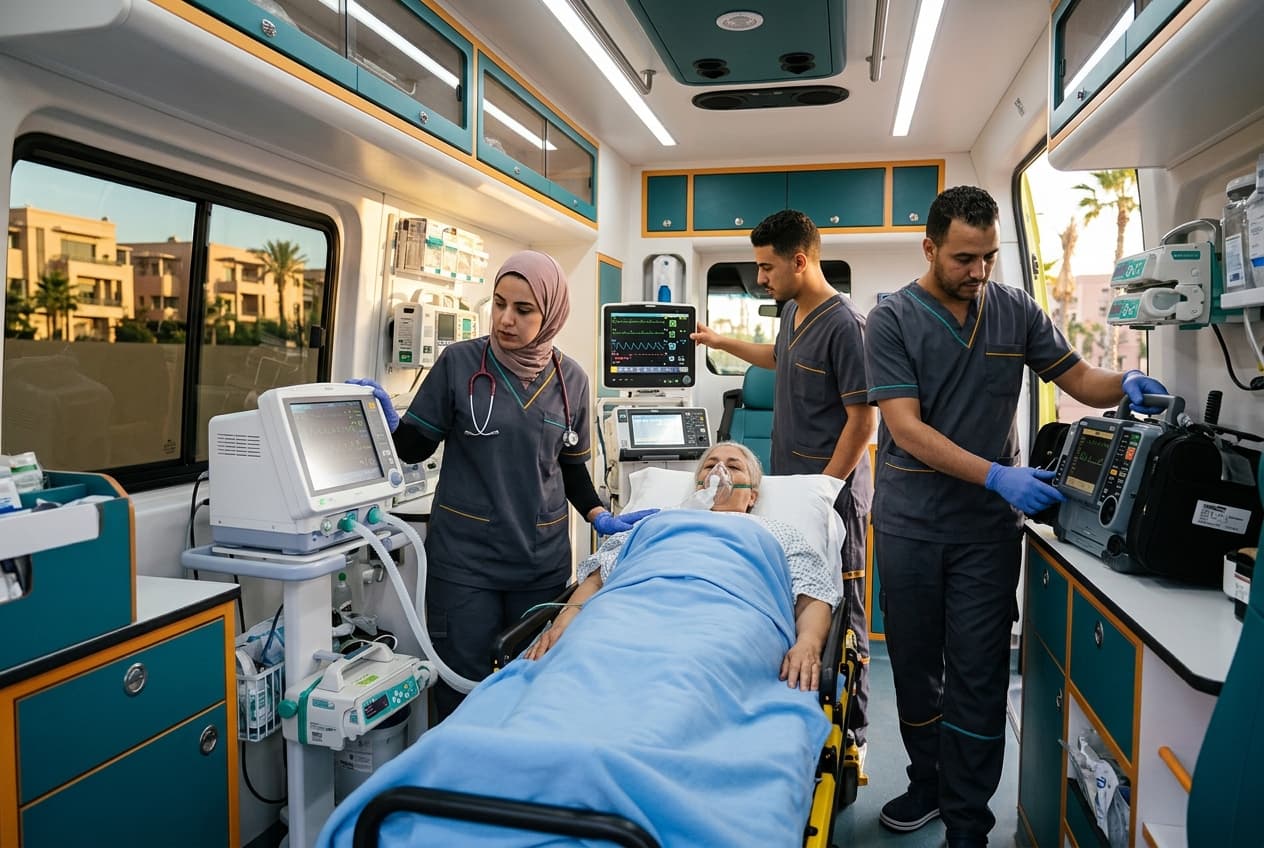
In a medical emergency in Marrakesh, the right reflex starts with the right number: SAMU 141 and Civil Protection 150 for a life-threatening emergency, Police 19 and the Royal Gendarmerie 177 for security matters. Knowing these numbers in advance and knowing what information to give saves precious, sometimes decisive, time. SOS Nursing is a private medical-transport and home-care service: we do not replace these public services and do not use their names. We operate for scheduled transfers and stable, non-life-threatening situations, in several languages, as a complement to the public system. This guide sets out the useful numbers, explains when to call the public or the private service, details the first actions while waiting for help, and answers the questions of families and travellers alike.
For a life-threatening medical emergency, dial the SAMU on 141 or Civil Protection on 150, which also provides rescue services to casualties and firefighting.
The emergency numbers to know in Marrakesh
For a life-threatening medical emergency, dial the SAMU on 141 or Civil Protection on 150, which also provides rescue services to casualties and firefighting. For a security emergency, the Police are reachable on 19 in town and the Royal Gendarmerie on 177 on roads and on the outskirts. These numbers are free, accessible from a landline or mobile, and reachable 24/7, all year round. Save them in your contacts right now and teach them to the children and elderly people in the household. Also display them on the fridge or near the home telephone, where everyone can find them in a moment of panic.
When to call the public service, when to call a private ambulance
Call 141 or 150 in a life-threatening situation: cardiac arrest, severe breathing difficulty, chest pain, loss of consciousness, major haemorrhage, serious accident, signs of a stroke (drooping mouth, an arm that falls, slurred speech). These are situations where every minute counts and where only the public emergency system is suitable. A private ambulance such as SOS Nursing is suited to a scheduled transfer (hospital discharge, transfer between clinics, medical appointment, dialysis session) or a stable, non-life-threatening situation, with a time slot arranged in advance. If you are in any doubt about the severity, always favour the public service: it is better to make one call too many than to delay care. The private service takes over once the situation is stabilised and non-life-threatening.
What information to give on the phone
The quality of your call determines how quickly help arrives. Clearly give the precise address (neighbourhood, street, landmark, name of the riad or residence, floor), the number of casualties and their approximate age. Describe the person's condition: are they conscious, are they breathing, are they bleeding, are they complaining of chest pain? Give your call-back number and stay reachable. Never hang up before the operator allows you to: they can guide you through the first actions and need details. If possible, designate someone to guide the ambulance at the entrance, especially in the Medina where the alleyways are hard to access.
The first actions while waiting for help
A few simple actions can save a life before help arrives. If the person is unconscious but breathing, place them in the recovery position to prevent them from choking. In the event of cardiac arrest (unconscious and not breathing), begin chest compressions (firm, regular pressure on the chest) following the operator's instructions. For a haemorrhage, apply pressure to the wound with a clean cloth. In the event of a faint, lay the person down, loosen their clothing, and give them nothing to drink or eat. Keep calm: a panicking entourage delays useful actions, whereas a person who acts methodically improves the chances of recovery.
Tourist emergencies: the language barrier
Travellers can struggle to make themselves understood by the public services, which mainly answer in Arabic and French. This language barrier generates stress and sometimes wastes precious time in describing symptoms or giving the address. SOS Nursing offers multilingual support (French, Arabic, English, Spanish, German) for transport and non-life-threatening care, working with your hotel, your riad, and your travel insurance. For a life-threatening emergency, 141 and 150 remain the priority: ask for help at the hotel reception, which can translate and clarify the location. Remember to travel with a sheet summarising your medical history and treatments, ideally translated.
Preparing the home and the family for an emergency
Planning ahead reduces the panic on the day an emergency strikes. Put together an emergency sheet for each member of the household: name, age, blood group if known, allergies, current treatments, chronic illnesses, and treating doctor. Keep a first-aid kit and the list of useful numbers within reach. For an elderly or frail person living alone, consider a personal-alarm system and inform a trusted neighbour or relative. Identify in advance the nearest clinic or hospital and the route to reach it. These simple preparations allow the whole family to react quickly and correctly when the moment comes.
What we are not
It is important to be transparent about our role. SOS Nursing is neither the SAMU nor Civil Protection and does not use these public names. We are an independent private provider of medical transport and home care: for any life-threatening emergency, the first call must always be 141 (SAMU) or 150 (Civil Protection). Our added value lies in scheduled transfers, stable non-life-threatening situations, and multilingual support, as a complement to — never a replacement for — the public system. This clarity protects patients: confusing a private service with the public emergency service could delay life-saving care.