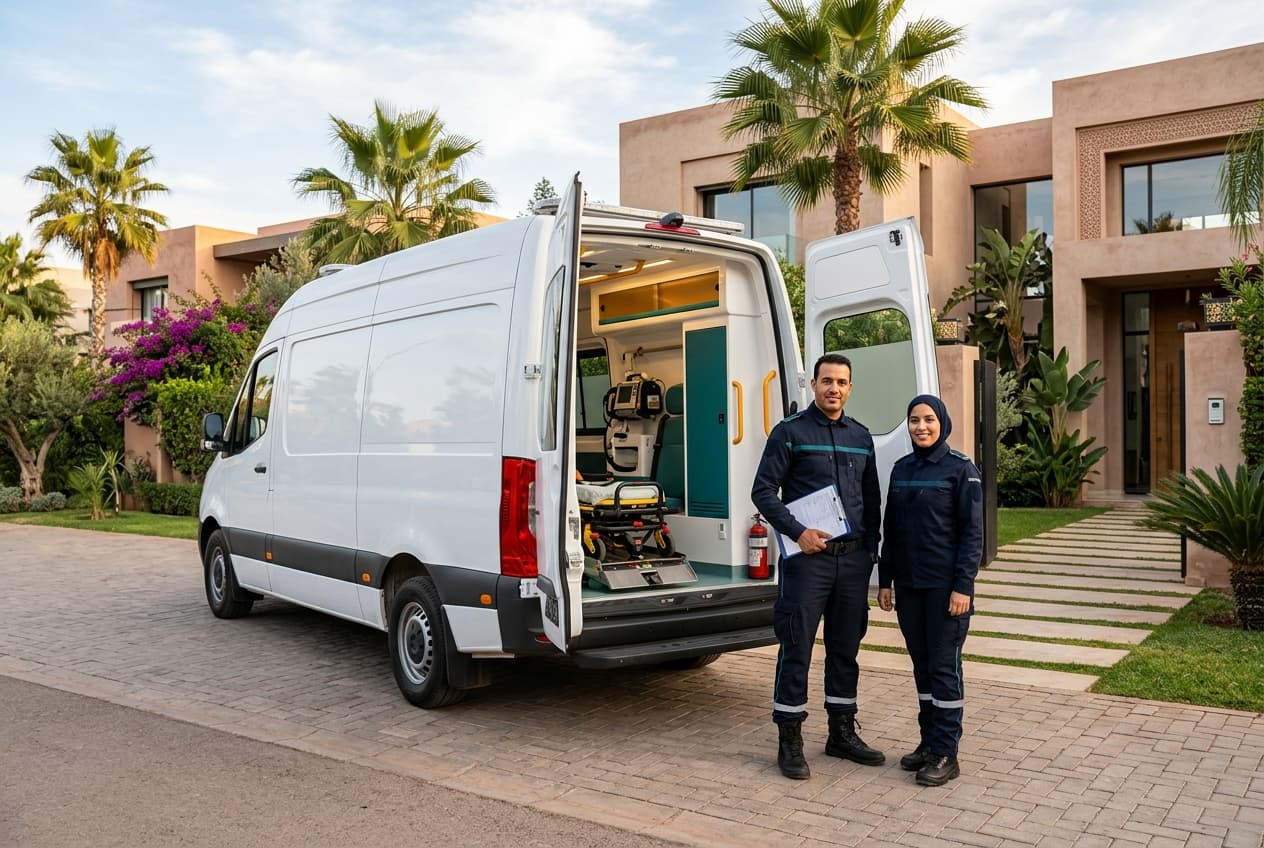
Long-distance medical transport connects Marrakesh to the other cities of Morocco (Casablanca, Agadir, Rabat, Fez) or arranges a repatriation, with a vehicle and team suited to the patient's condition. Unlike an urban journey, the length of the trip demands particular attention to comfort, on-board medical equipment, and continuity of care over several hours on the road. The price is calculated mainly per kilometre and according to the level of medical equipment, and a firm quote is provided before departure. SOS Nursing is a private medical-transport provider: for an immediate life-threatening emergency, first call the SAMU (141) or Civil Protection (150). This guide explains when to choose a long-distance transfer, how the price is built up, what the ambulance carries, and how to prepare the journey properly with your insurer.
This service covers several common situations in Morocco.
When to choose long-distance transport
This service covers several common situations in Morocco. Most often it involves transfers between facilities (a Marrakesh clinic to a university hospital in Casablanca or Rabat) when a specialised technical platform is required: intensive care, neurosurgery, interventional cardiology, oncology. It also concerns returns home to another city after a hospital stay, or taking a patient to a referral centre for a scheduled examination or procedure. The choice between a basic, medical, or intensive-care ambulance depends on the patient's stability and is settled before departure, in coordination with the doctor. A poorly calibrated transfer (under-equipped medically) exposes the patient to risks on the road; this is why prior assessment is essential.
How the price is calculated
Over long distances, billing is mainly per kilometre, at around 7 to 12 DH/km observed on the market, to which the medical level, any tolls, and the vehicle's empty return are added. The medical level (oxygen, monitoring, nursing or medical presence) is the second item, followed by consumables and the time the team is committed. As a guide, Marrakesh–Casablanca is often between 3,800 and 5,200 DH, Marrakesh–Agadir between 3,200 and 4,600 DH, and Marrakesh–Rabat between 5,200 and 7,200 DH. These ranges vary according to the time of day (night, weekend), the patient's condition, and any need for a doctor on board. A firm quote, including travel costs, is provided before departure to avoid any unpleasant surprise on arrival.
Medical equipment on board
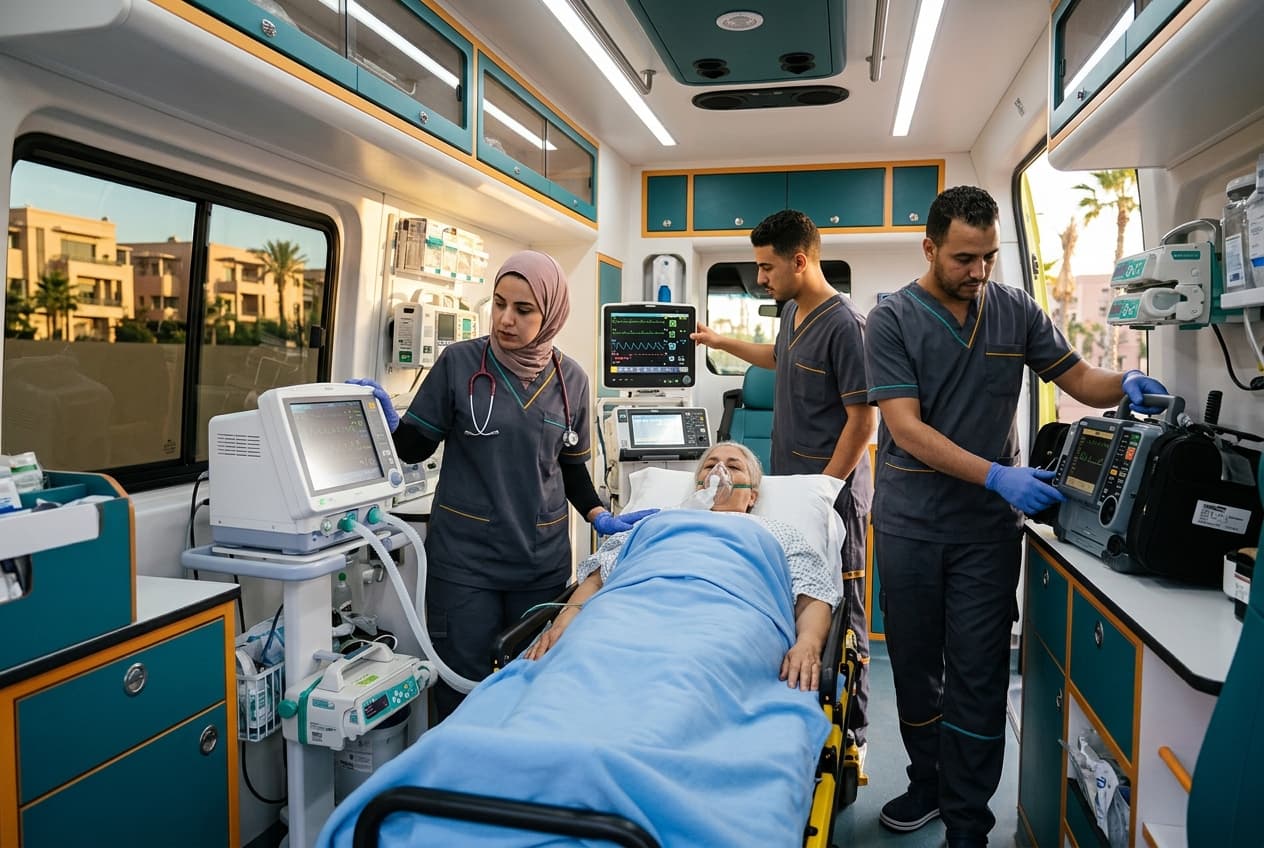
For a long journey, the team can carry oxygen, continuous monitoring of vital signs, a syringe driver for infused treatments, and a state-registered nurse, even a doctor for serious or unstable cases. The equipment is sized for the length of the trip: sufficient oxygen reserves, back-up batteries, an appropriate quantity of consumables. During the journey, the team monitors vital parameters, manages pain, administers the prescribed treatments, and adjusts the patient's position for their comfort. The consumables (oxygen, medication) and the care presence are specified in the quote to avoid any surprise. A stopover point can be planned on very long journeys to reassess the patient's condition.
Patient comfort over several hours on the road
Beyond medical safety, comfort is decisive on a journey of two to six hours. The vacuum mattress and the appropriate stretcher limit jolts and prevent pain and pressure sores in frail patients. Air conditioning, regular hydration, the management of natural needs, and breaks where the condition allows are all part of a well-organised transfer. For an elderly person, a post-operative or pained patient, these details transform the travel experience. A family companion can sometimes take a seat depending on the vehicle and the patient's condition, which reassures the patient; this option is confirmed at the time of booking.
Repatriation and liaison with the insurer
For a national or international repatriation, coordination with your insurer is central. To Ménara airport and then a medical flight, or by medical escort on a commercial flight (from about 6,500 DH on the market), we work in liaison with your insurer or your assistance company. The medical documents, the hospital discharge report, and fitness to travel (fit-to-fly for air travel) are checked ahead of departure. For foreign visitors, travel insurance often covers all or part of the repatriation, subject to prior agreement: notify your assistance company as early as possible. We provide the necessary supporting documents to facilitate financial coverage.
Safety, route, and managing the unexpected
A well-conducted long-distance transfer anticipates the hazards of the Moroccan road. The route is chosen to balance speed and the condition of the roads, taking into account the weather, the traffic, and the availability of emergency facilities along the way. The team has a protocol in case the patient's condition deteriorates: emergency medication, the option to divert to the nearest hospital, contact with the coordinating physician. The vehicle is checked before departure (fuel, oxygen, equipment) to avoid any immobilising breakdown. This rigorous preparation distinguishes a serious medical-transport provider from a simple transport vehicle, and underlines the importance of a medical assessment before setting the required level.
Preparing the journey properly
Good preparation makes the transfer smoother and the price reliable. Gather the medical report, current prescriptions, the latest examinations, the exact destination (name and ward of the receiving facility), and the contact details of someone on site. Confirm the admission with the receiving ward to avoid a needless wait on arrival. Flag any specific needs: oxygen, infusion, tube feeding, reduced mobility. A planned departure allows a firm price to be set in advance and the right team to be booked; the precise price, including travel costs, is confirmed before departure. The more complete the information provided, the safer and calmer the transfer will be.