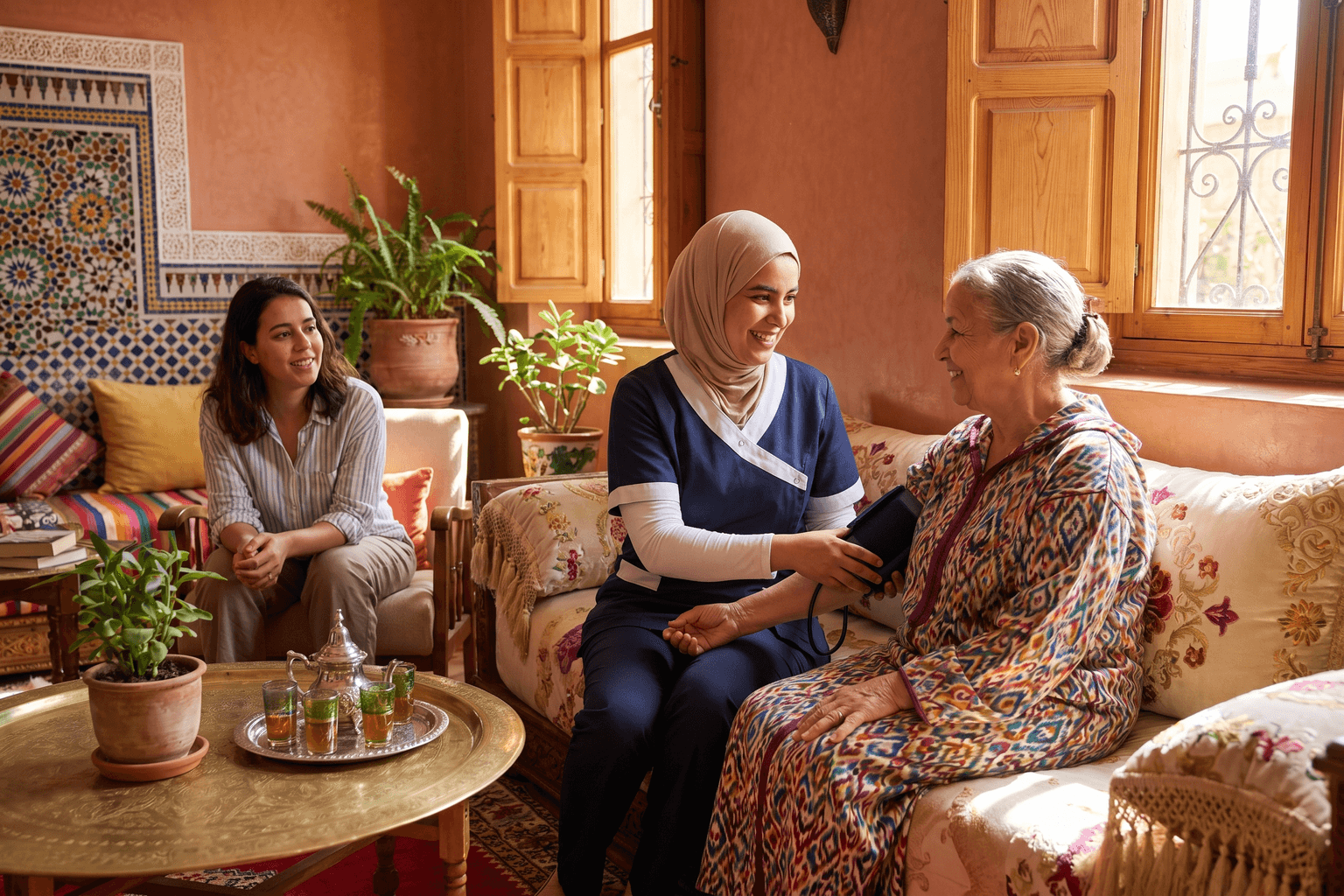
Home help for the elderly in Marrakesh brings together the non-medical services that make daily life easier and preserve independence: help with washing, meals, mobility, shopping, light housekeeping, companionship, and accompaniment on outings. These services are provided by vetted home-care assistants and home carers, distinct from nursing care, which is the remit of qualified staff. The aim is to stay at home safely, with dignity and warmth, in a familiar setting often preferred to an institution. In Marrakesh, the help can respect the person's cultural habits and language, which are key factors in well-being and acceptance. This guide details the home-help services, the boundary with the medical side, social support, help for carers, the criteria of trust, and questions of cost and reimbursement.
Home help covers all the everyday tasks that become difficult with age.
Home-help services
Home help covers all the everyday tasks that become difficult with age. This includes washing and hygiene, dressing, preparing meals and helping to eat them, getting up and going to bed, transfers and help with mobility, light housekeeping, shopping, and accompaniment to appointments. The carer also sees to hydration, a clean and safe environment, and a gentle stimulation of independence: the person is helped to do things rather than having everything done for them, in order to preserve their abilities. These are non-medical services intended to support independence and comfort. Their volume is adjustable, from a few hours a week to a daily presence, according to needs and how the person develops.
What is medical (and therefore for a nurse)
The distinction between help and care is fundamental for the person's safety. A non-clinical home carer carries out no medical procedure: no injection, no dressing, no infusion, no administration of injectable treatment, no wound or pressure-sore care. These actions are reserved for a state-registered nurse, on prescription. The carer can, however, remind the person to take prepared medication, help with a simple oral dose, and, above all, report any change in condition (loss of appetite, confusion, pain, skin redness) to the family or the nurse. This alerting role is valuable. When medical needs arise, home help and nursing care are combined in a coordinated arrangement, each within its own remit.
Support and social connection
Beyond practical tasks, home help plays an essential role against isolation, the silent scourge of old age. Companionship, conversation, walks, and accompanied outings (market, Medina, mosque, appointments, family visits) maintain social connection and morale. In Marrakesh, the support can respect local habits and traditions: meal times and dishes, religious practices, the language spoken. Sharing a glass of tea, listening to memories, encouraging an enjoyable activity matter as much as hygiene tasks for the person's well-being. This human dimension is often what families appreciate most, because it brings life back to the daily routine of an elderly relative and breaks the loneliness of the days.
Adapting the home and preventing risks
An adapted home is the basis for safely staying at home. The home carer helps to spot and limit risks: tidying away slippery rugs and obstacles, ensuring good lighting, flagging the need for grab rails in the bathroom and toilet, seeing to closed, non-slip footwear. They monitor hydration and nutrition, particularly important in the hot season in Marrakesh where dehydration threatens elderly people. They also see to domestic safety (gas, water, appliances). These daily attentions prevent falls — the leading cause of loss of independence in seniors — and incidents. By flagging risky situations, the carer makes it possible to act before the accident rather than to suffer it.
Supporting and relieving carers
Behind every elderly person kept at home, there is often a family carer under pressure. Many families take on the support of an elderly parent alone, at the cost of their fatigue, their work, and their personal life. Home help, occasional or regular, offers respite to carers and secures the sensitive moments: the night, the weekend, periods of absence or leave. It allows relatives to catch their breath, to rest, and to keep going over time without burning out or feeling guilty. The pace is adjustable, from a few hours a week to a daily presence, scalable according to needs. Supporting the carer is not a luxury: it is a condition for the support to remain possible and of good quality over the long term.
Trust, vetting, and coordination
Letting a person into the home of a vulnerable relative calls for solid trust. Each carer offered by SOS Nursing is selected and vetted (identity, references, experience) and then followed by a reachable coordination, unlike one-to-one arrangements, which are more uncertain. The help plan is defined with the family and the elderly person, then reassessed according to how needs develop. Continuity is ensured if the usual carer is absent, which avoids painful breaks. Respect for the person's dignity, modesty, and habits is a permanent requirement. This professional organisation brings a peace of mind that informal arrangements cannot provide, and protects both the elderly person and their family.
Cost and coverage
Anticipating the budget allows you to build sustainable support. The cost of home help depends on the volume of hours, the pace (day, evening, weekend), and the level of help required. Unlike prescribed nursing care, non-medical home help (home-care assistant, help with meals and washing, companionship) is generally not reimbursed by the AMO/CNSS, because it does not correspond to a codified care procedure. Some insurance policies or mutual funds may provide assistance benefits: check your cover. It is better to prioritise the essential needs and increase the volume of help gradually as things develop, rather than over-sizing from the outset. A clear quote and a single point of contact who coordinates help and any care simplify the organisation and control of the budget.