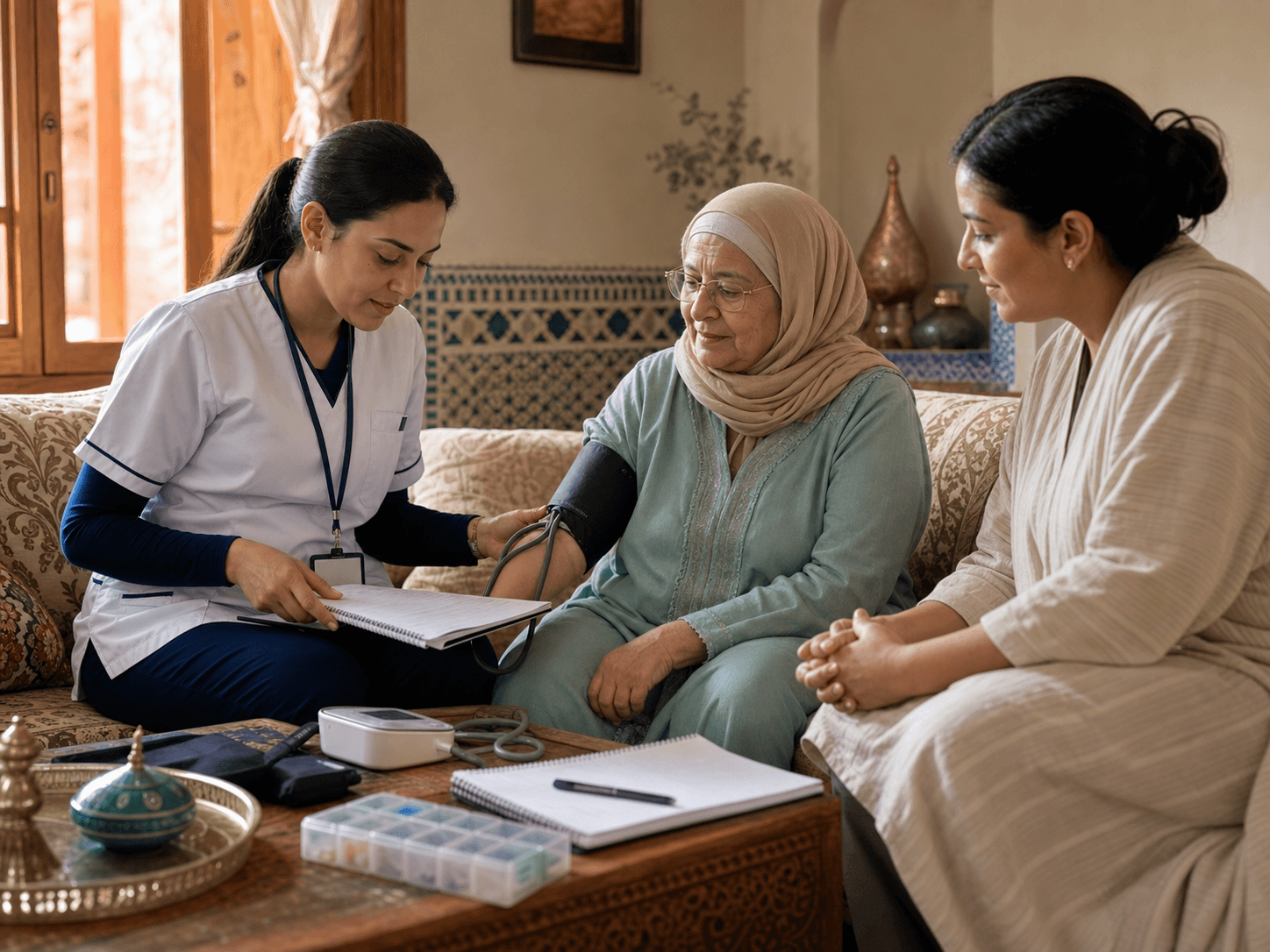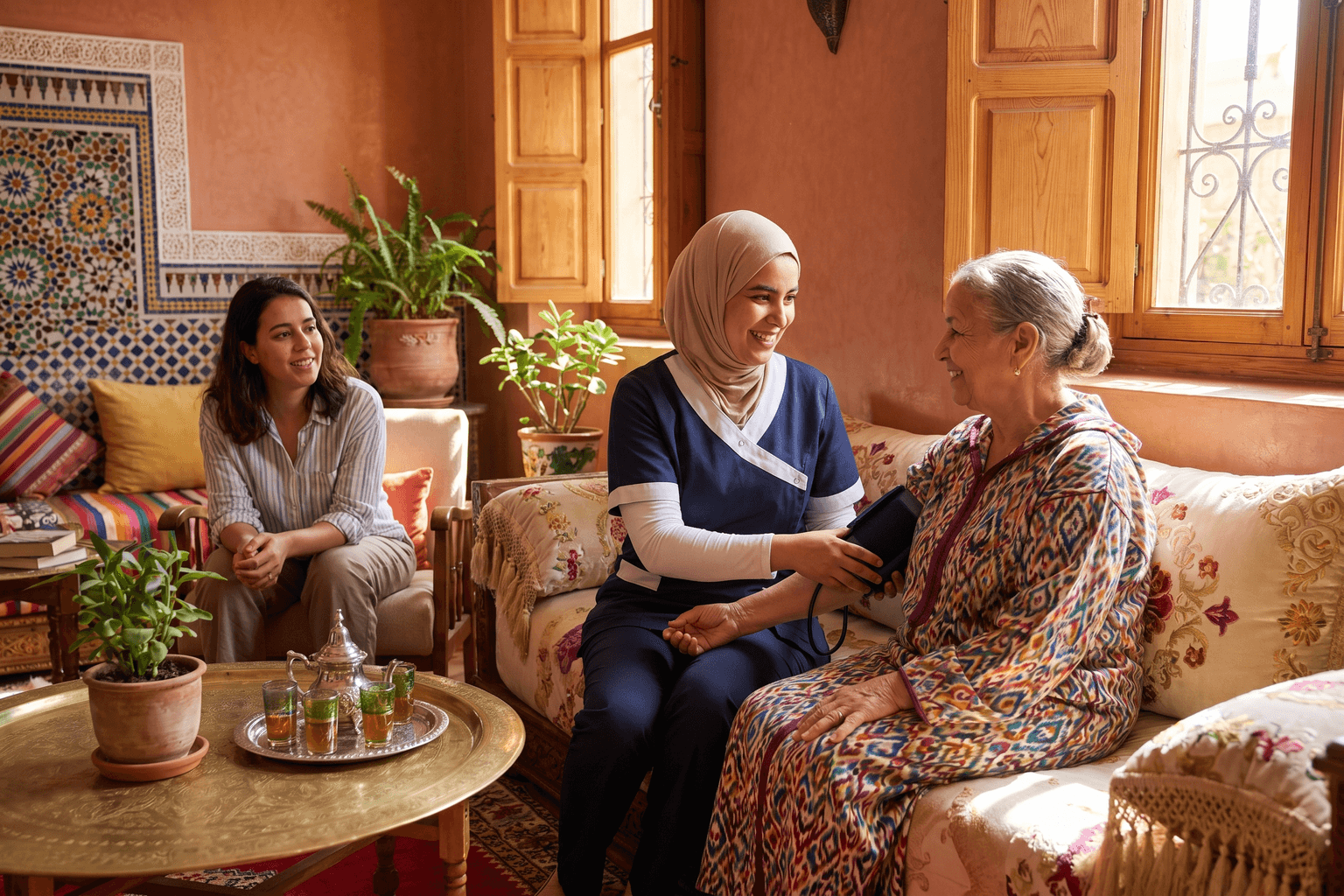
Before committing to home care, it is worth understanding exactly what your insurance covers. Between the mandatory AMO, complementary mutual insurance, private policies, and, for visitors, travel insurance, levels of cover differ widely. This guide helps you make sense of your nursing care coverage in Morocco, anticipate your out-of-pocket costs, and build a claim that maximises your reimbursement.
The Moroccan system is built in several layers.
Morocco's health insurance landscape
The Moroccan system is built in several layers. The AMO forms the foundation for employees, civil servants, and — more recently — the self-employed. Above this, mutual insurance funds and private schemes supplement basic coverage. The RAMED, now known as AMO Tadamon, targets people in financially precarious situations. Foreign visitors, meanwhile, depend on their travel insurance. Each system has its own rules, rates, and limits. Understanding which layer applies to you is the prerequisite for any coverage assessment. The same procedure will not be reimbursed in the same way depending on your status and your contracts.
What basic AMO covers
The AMO covers a portion of healthcare costs, including certain prescribed nursing acts, based on a reference tariff and a schedule of acts. It never reimburses the full amount: a co-payment always remains. The reimbursement rate depends on the nature of the act and the scheme. For home care, a medical prescription is indispensable and only coded acts are eligible. Knowing the AMO's limits avoids unpleasant surprises: it provides a solid foundation, but is rarely sufficient on its own for extended or technical care.
Mutual insurance and complementary schemes
Complementary health insurance often makes the real difference to the co-payment. Employer-provided funds, occupational mutual schemes, or individual private policies reimburse all or part of what the AMO leaves at your expense, sometimes going beyond the reference tariff. Cover varies enormously: annual ceilings, reimbursement rates, covered acts, and waiting periods all differ. Some policies include home nursing generously; others exclude or cap it. Before committing to significant spending, read your policy carefully or ask your complementary fund specifically about home nursing. A good complementary scheme turns a prohibitive co-payment into a manageable, predictable expense.
Private insurance and specific policies
Beyond standard mutual insurance, some private insurers offer extended health contracts, sometimes linked to income-protection or assistance products. These may cover home hospitalisation, long-term care, or specific services. Their value depends on your situation: an older person, someone with a chronic condition, or a family planning ahead may find useful guarantees. But these contracts also have exclusions, ceilings, and age or health conditions. Reading the small print is essential. A broker or your insurer can help you compare options, keeping your actual home nursing needs in mind.
Home care: what is reimbursable
Not all home care is equal in terms of insurance coverage. Technical nursing acts on prescription — injections, dressings, infusions, monitoring — are the most likely to be covered, subject to prescription and correct coding. Non-medical home help, such as a care aide or a non-nursing night carer, is rarely covered by the AMO and depends on the specific guarantees of your complementary policy. Distinguishing medical care from autonomy support is therefore crucial for anticipating what will be covered. SOS Nursing helps you identify, among the services provided, which qualify for reimbursement and which will remain at your expense.
The case of tourists and expatriates
Foreign visitors and expatriates operate under a different logic. Tourists depend on their travel insurance or premium bank card, which often covers unforeseen care under specific conditions. Expatriates may have an international health insurance policy. In all cases, keep detailed invoices and care reports — essential for reimbursement by the home-country insurer. Some insurers require prior authorisation before any care. SOS Nursing provides clear, readable documentation that facilitates these often cross-border processes. For visitors, checking cover before travelling and keeping assistance contact details handy avoids many complications in the event of a health problem in Marrakech.
Maximising your reimbursement
A few habits maximise your reimbursement. Always request a clear prescription listing the acts, their frequency, and their duration. Insist on itemised invoices with act codes. Verify your entitlement and affiliation before care begins. Observe submission deadlines, which are often limited. Submit to the AMO first, then to your mutual fund, in the right order. Keep originals of all documents. These simple but decisive practices prevent rejections and speed up reimbursements. SOS Nursing's transparent billing and care reports give you the supporting documents you need; it is then up to you to submit them on time and in full to your insurers.
How SOS Nursing supports you
SOS Nursing does not replace your insurer, but it does simplify the process. From the estimate onwards, the coordinator explains the cost of services and distinguishes potentially reimbursable care from non-medical support. We provide itemised invoices and care reports useful to your claim, and ensure consistency between the prescription and the acts performed — a prerequisite for insurer acceptance. Our model — salaried nurses and clear billing — minimises the ambiguities that cause rejection. The goal: to help you make full use of your entitlements, and to access the care you need without financial concerns becoming an obstacle.